World in numbers · Number story 275
How many urban residents lived in slums or informal settlements in 2024?
A city-population estimate anchored in the UN’s 2024 housing indicator.
7 minute read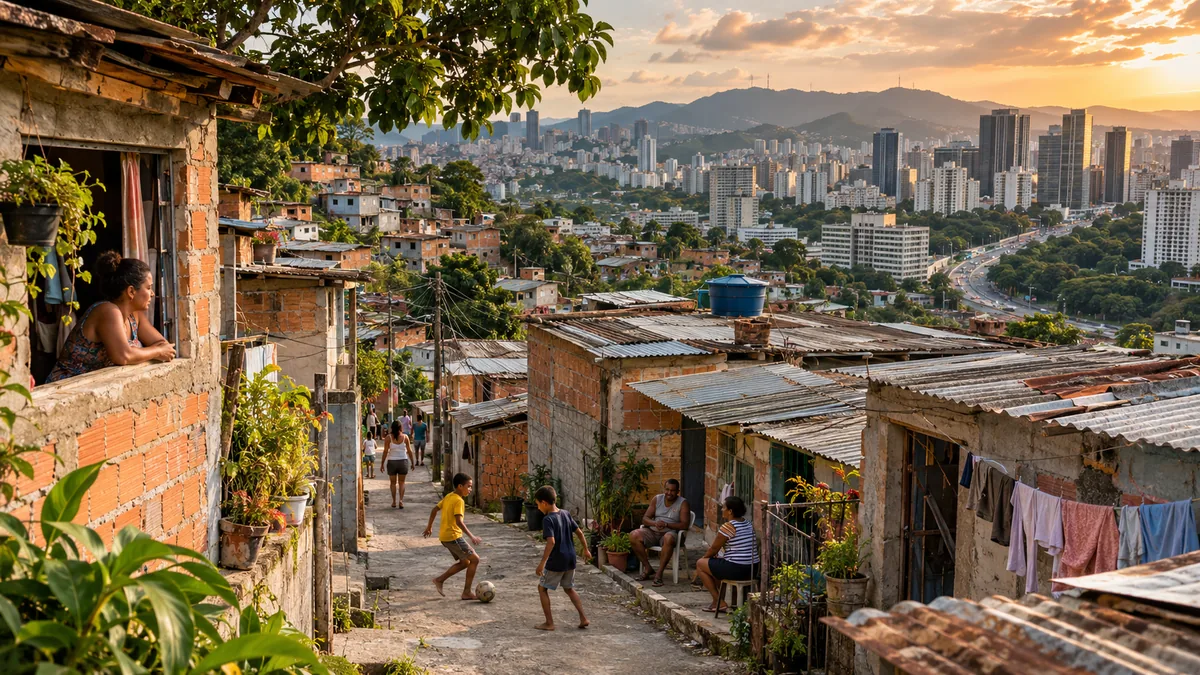
roughly 4.7 billion urban residents × 0.248 ≈ 1.17 billion people
What the housing measure describes
The United Nations reports that about 1.16 billion urban residents lived in slums or informal settlements in 2024, equivalent to 24.8 percent of urban residents. This is a people count, not the number of dwellings or neighborhoods. The indicator concerns housing conditions and access to essentials; it should not be taken as a judgment about the people who live there. Some settlements have strong social networks and economic activity even while residents face insecure tenure, crowding, or poor services. Keeping the measurement focused on infrastructure and housing avoids turning a statistical category into a stereotype.
Multiply the urban base by a share
A transparent model starts with roughly 4.7 billion urban residents worldwide in 2024 and applies the UN’s 24.8 percent share. Multiplication gives about 1.166 billion, which rounds to 1.17 billion and is consistent with the published 1.16 billion. The urban population is a rounded modelling base inferred from the benchmark ratio, not a separate precise UN population claim here. The arithmetic reveals why one-quarter of city residents can be an enormous absolute number. It also shows why using the full world population as the denominator would overstate the count for an urban-only indicator.
Reverse the calculation as a check
Divide 1.16 billion by 0.248: the implied urban base is about 4.68 billion. This is an independent consistency check on the percentage and headcount as published together. Now compare with a rough global population of eight billion: an urban base below that ceiling is plausible, and 1.16 billion is roughly one-seventh of all people. A mistaken calculation of 11.6 billion would exceed the entire world population. A mistaken result of 11.6 million would correspond to far less than one percent of the implied urban base. Reverse division exposes both decimal-place errors quickly.
Why a falling share can coexist with a rising count
Housing indicators often move in two directions at once. A city system may improve the proportion of residents with adequate services while its population grows even faster. Then the share living in slums can fall while the absolute count rises. The UN describes precisely this tension in its Goal 11 discussion. It means a percentage trend alone cannot tell us whether fewer people are affected. To understand change, multiply each year’s urban population by that year’s condition share. For planning water, sanitation, safe housing, and transport, the headcount and its location matter as much as the rate.
Stress-test the estimate
At a broad urban base of 4.5 billion and a one-fifth share, the model gives 900 million. At five billion and a three-tenths share, it gives 1.5 billion. The reported 1.16 billion falls inside that range, indicating a scale around a billion rather than a few million. The range is deliberately broad because settlement definitions, survey coverage, and local housing conditions differ. A neighborhood-level model would need household size, dwelling counts, and specific service access; a single global rate would be a poor substitute for those local measurements.
The answer and the next estimate
About 1.16 billion urban residents lived in slums or informal settlements in 2024 according to the UN’s Goal 11 reporting. Urban population times the measured share reconstructs the scale, and reverse division checks the implied denominator. This answer is useful for orienting the size of an infrastructure challenge, but it does not tell us how many homes to build or which services to prioritize. Those questions require local maps, household data, affordability, and the choices of residents themselves. The transferable estimation habit is to preserve the denominator and report both the share and the affected population.


