World in numbers · Number story 232
How much aquatic animal food comes from aquaculture?
A production split explains why farmed fish and other aquatic animals passed 100 million tonnes in 2024.
7 minute read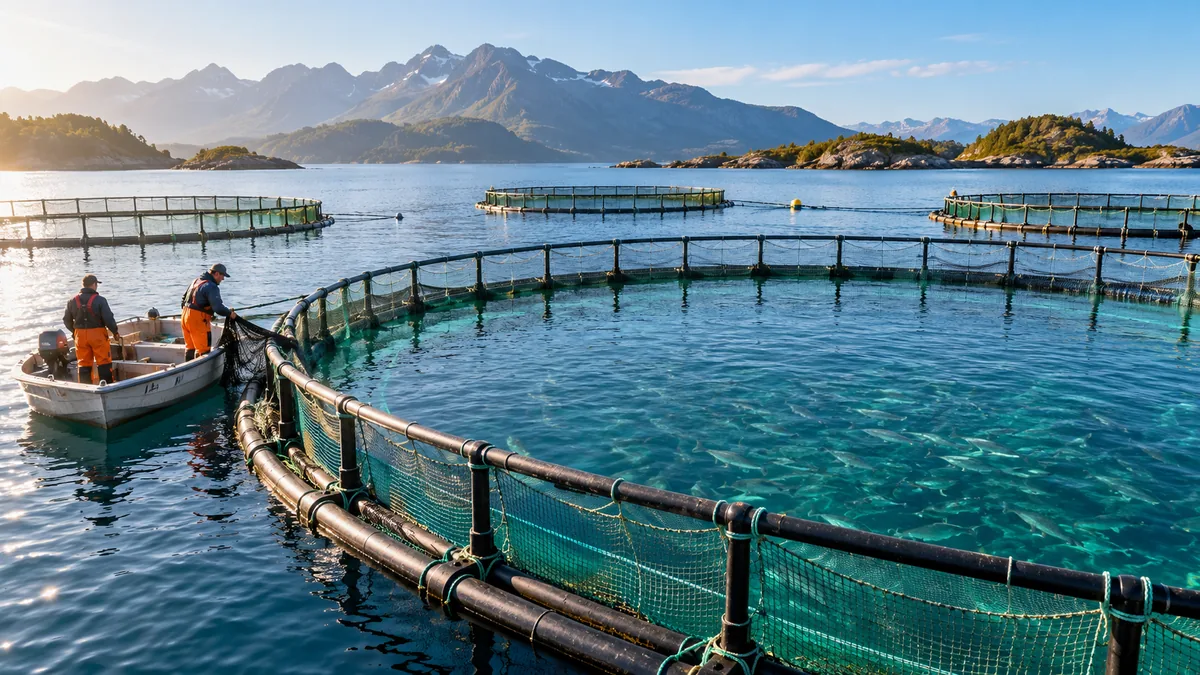
about 195 million tonnes of aquatic animals × 53% from aquaculture ≈ 103 million tonnes
Start by separating fish farms from wild catch
The Food and Agriculture Organization's SOFIA 2026 release estimates that aquaculture produced about 103 million tonnes of aquatic animals in 2024. Aquaculture means farming aquatic organisms; capture fisheries harvest wild stocks. These are different supply systems, even when their products look similar on a plate. The 103-million-tonne number is production weight of aquatic animals, not the weight of every fish meal eaten by people. Some animals are processed, exported, or used for other purposes. FAO also reports algae production separately. If algae are added without changing the question, the total changes for a definitional reason rather than because the animal estimate was wrong.
Use the share of aquatic animal production
FAO says total aquatic animal production from fisheries and aquaculture reached about 195 million tonnes in 2024, and aquaculture supplied approximately 53 percent. Multiplying 195 by 0.53 gives 103.35 million tonnes. Round this to 103 million, consistent with FAO's published aquaculture figure. If the share were 45 percent, the product would be 88 million tonnes; at 60 percent it would be 117 million. The model therefore supports an answer around one hundred million tonnes. The equation works because both numerator and denominator refer to aquatic animals. Substituting the larger 235-million-tonne total, which includes algae, would quietly mix categories and overstate the result.
Check against wild production
The same FAO release says capture fisheries produced about 92 million tonnes of aquatic animals in 2024. Add 103 million farmed tonnes and 92 million captured tonnes: the result is 195 million, matching the overall aquatic-animal total. This is an independent compositional check, not merely a repeat of the 53-percent multiplication. It also shows the scale of the transition: in that year farmed aquatic animals slightly exceeded wild-caught aquatic animals. The comparison should not be interpreted as meaning every species is farmed more than it is caught. Tuna, salmon, shrimp, molluscs, and freshwater fish have very different production patterns and ecological constraints.
Why production is not consumption
FAO says 89 percent of aquatic-animal production goes to human consumption, but this does not make 103 million tonnes equal to edible fillet weight. Processing removes shells, bones, heads, and other material; inventories and trade change when and where food is available. A household-demand calculation would need edible yield and waste assumptions. The 2024 report also notes that including algae raises all aquaculture production to about 141 million tonnes. That difference is a reminder to read the noun after the number. An estimate of farmed aquatic animals should not quietly become an estimate of all farmed aquatic organisms.
What the scale teaches
For 2024, the best rounded answer is 103 million tonnes of farmed aquatic animals worldwide. Multiplying the total aquatic-animal production by aquaculture's share builds the Fermi estimate; adding farmed and wild components checks the accounting. Neither calculation says whether production is environmentally sustainable in every place. Water quality, feed, disease, labour, and habitat conditions vary across farms and species. To estimate one region, replace the global share with regional production data and specify whether algae are included. The general lesson is to use a total and a share only when both use the same units and boundaries. A precise-looking answer from mismatched categories is less useful than a rounded one with honest definitions.


