World in numbers · Number story 231
How much of the world's land is forest?
A land-area calculation approaches the FAO estimate of 4.14 billion hectares of forest in 2025.
7 minute read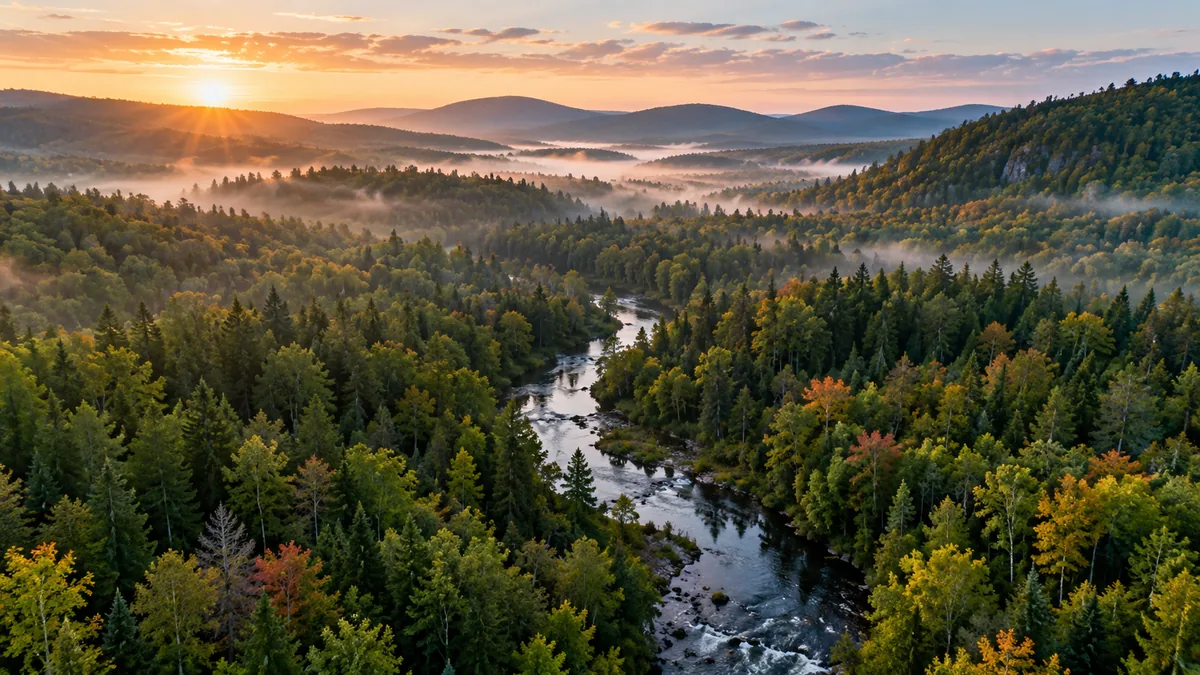
about 13 billion hectares of global land × 32% forest cover ≈ 4.16 billion hectares
A forest is an area, not a tree count
A stand of trees can feel boundless from the ground, but a satellite view turns forest into measurable area. The Food and Agriculture Organization's Global Forest Resources Assessment 2025 reports about 4.14 billion hectares of forest worldwide. The unit is hectares of land meeting a forest definition, not individual trees and not the annual area newly planted. One hectare is 10,000 square metres, or one hundredth of a square kilometre. Forest may include young regrowth as well as mature stands, while trees in a city park do not automatically turn the entire city into forest. The boundary chosen for mapping matters as much as the multiplication.
Start with Earth's land surface
FAO says forests cover about 32 percent of global land area. Round the relevant land area to roughly 13 billion hectares. Multiply 13 billion by 0.32 to get 4.16 billion hectares, almost exactly the reported 4.14 billion. The land-area anchor is deliberately coarse and the forest share is itself rounded, so writing 4.1600 billion would imply unjustified precision. If the assumed share were 25 percent, the result would be 3.25 billion hectares; at 40 percent it would be 5.2 billion. That range shows why the answer belongs in billions of hectares rather than millions. Convert 4.14 billion hectares to about 41.4 million square kilometres only after the hectare estimate is clear.
An independent per-person comparison
FAO describes the forest total as roughly 0.5 hectares per person. Multiplying a world population around 8.2 billion by half a hectare yields about 4.1 billion hectares, independently recovering the same scale without starting from total land area. This is an accounting average, not an allocation of land to individuals. Most people do not have a half-hectare forest nearby, and forest cover is highly uneven geographically. FAO also says five large countries hold more than half of the world's forests. An equal-per-person interpretation would erase that concentration. Still, the per-person ratio is a quick check that a missing zero in the land-area model has not slipped through.
Why area and change must stay separate
A stock of 4.14 billion hectares can coexist with substantial deforestation and with regrowth elsewhere. FAO's 2025 assessment gives a deforestation rate of about 10.9 million hectares annually, while net forest-area change reflects losses and gains together. Dividing 10.9 million by 4.14 billion gives roughly 0.26 percent of the current forest area, but that ratio does not mean exactly that fraction disappears permanently each year. Land can be cleared, restored, reclassified, or measured differently. A local conservation question needs its own forest boundaries, quality measures, and time series. Two areas with identical hectares can differ dramatically in biodiversity and carbon storage.
What the estimate can do
The practical global answer for 2025 is approximately 4.14 billion hectares of forest. Land surface multiplied by forest share is the first Fermi model; the half-hectare-per-person conversion is a separate reality check. Neither equation counts trees or proves that every forest is healthy. That distinction opens better follow-up questions: how much is primary forest, what fraction is protected, and where are losses occurring? For a local project, begin with mapped land cover rather than transferring a worldwide 32-percent share to a particular landscape. Good estimation keeps the unit, definition, and observation date beside the headline so a large number remains useful.


