World in numbers · Number story 223
How many mobile-cellular subscriptions exist worldwide?
The total exceeds the number of people because one person can hold multiple subscriptions.
7 minute read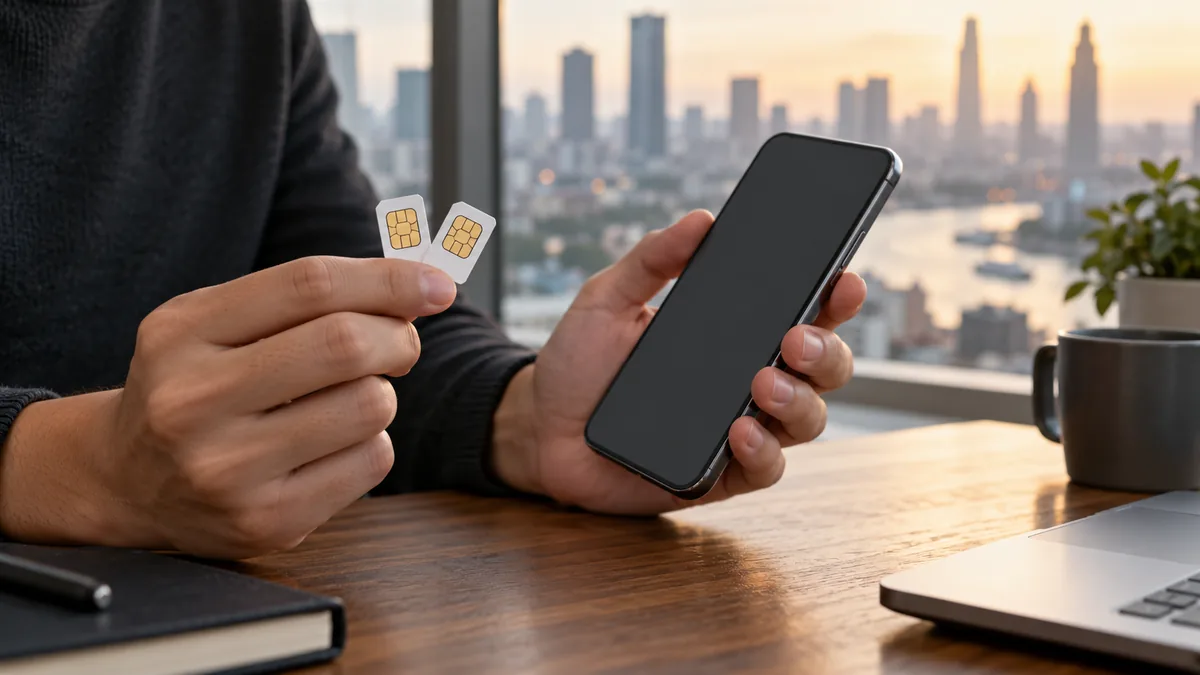
about 8.2 billion people × 1.12 mobile subscriptions per person ≈ 9.2 billion subscriptions
Count connections, not owners
The International Telecommunication Union estimates 9.2 billion mobile-cellular subscriptions in 2025, or 112 for every hundred inhabitants. The apparent paradox is a definition problem: a subscription is a service relationship, not a distinct human being. One person can maintain a personal line, a work line, and a travel SIM; some subscriptions serve connected equipment. Meanwhile another person may have no mobile service at all. A smartphone lying on a desk is not necessarily an active subscription, and an active subscription does not prove that its owner uses mobile broadband. Treating 9.2 billion as a count of unique mobile users would erase this difference and lead to a misleading claim about universal access.
Population times connections per person
For a quick model, round the world population to 8.2 billion people and use ITU's 112 subscriptions per hundred inhabitants as 1.12 per person. Multiply: 8.2 billion times 1.12 is 9.184 billion, or roughly 9.2 billion subscriptions. The 8.2 billion is a rounded denominator, so extra decimals would be false precision. A sensitivity check is easy: at one subscription per person the result is 8.2 billion; at 1.25 it becomes 10.25 billion. The published figure sits in that plausible band. A ratio above one is possible because the numerator counts accounts and the denominator counts people, two different things.
Use the regional contrast as another check
ITU reports roughly 142 mobile-cellular subscriptions per hundred inhabitants in high-income countries and 70 in low-income countries in 2025. The world average of 112 falls between those two values. This regional ordering is an independent reasonableness check on the global ratio: a worldwide figure far above every regional value, or far below every one, would demand an explanation. It also warns against copying the global average into a country forecast. An area with many prepaid lines, company accounts, or connected devices might exceed one subscription per resident. Another area can have widespread household phone sharing and still have fewer subscriptions than inhabitants. The ratio is a network statistic, not a direct measure of inclusion.
What a subscription cannot reveal
Mobile-cellular and mobile-broadband are related but distinct series. ITU says mobile broadband accounted for 89 percent of mobile subscriptions in 2025. Multiplying 9.2 billion by 0.89 gives around 8.2 billion broadband subscriptions, but even that is not 8.2 billion individual internet users. People may hold more than one broadband plan; a device plan can be used by a machine; an account may be inactive in everyday terms despite meeting the reporting definition. To estimate unique people online, start with person-level survey or ITU internet-use statistics instead. The best equation is the one whose unit remains the same from first factor to final answer.
Try a local operator model
Imagine a hypothetical country with 40 million residents. Suppose 30 million maintain one line and five million of those maintain a second line. The total is 35 million subscriptions, or 87.5 per hundred residents, despite only 30 million people having at least one. If businesses add three million machine lines, subscriptions rise to 38 million while unique human users remain 30 million. That simple exercise explains why a high subscription count can coexist with a digital divide. Globally the best rounded answer for 2025 is 9.2 billion mobile-cellular subscriptions. Population times subscriptions per resident makes the scale visible, and regional rates test whether the ratio is sensible. Always keep connections separate from people.


