World in numbers · Number story 218
How much land does agriculture use worldwide?
A share of the planet's land gives about 4.6 billion hectares in 2024, most of it outside cropland.
7 minute read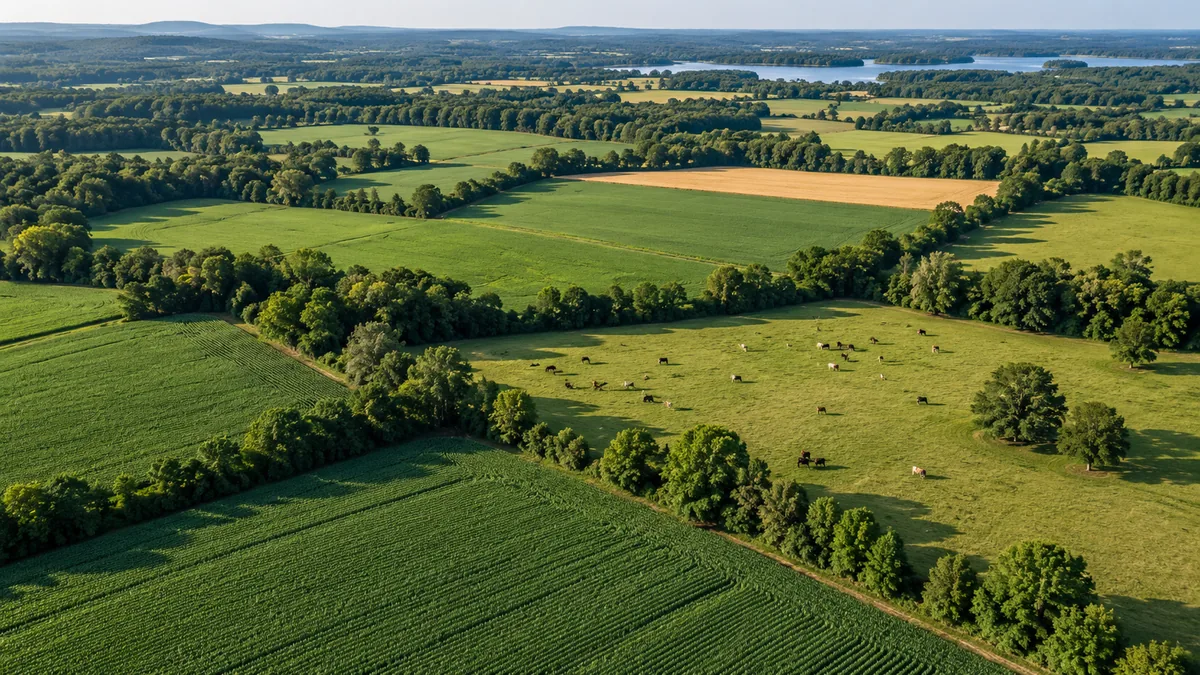
roughly 13 billion hectares of land outside Antarctica × an illustrative 35% agricultural share ≈ 4.6 billion hectares
Fields are only part of the picture
Picture a field of wheat and it is natural to imagine that agricultural land means rows of crops. In FAO land statistics, agricultural land also includes permanent meadows and pastures used for grazing. FAO reports about 4.6 billion hectares of agricultural land worldwide in 2024, more than one-third of total land area. The figure is a land-use stock, not the amount harvested in one growing season. A hectare may support two crop harvests in a year but remains one hectare of physical land.
The distinction matters because a harvested-area statistic can count the same land more than once when multiple crops are grown. Conversely, large pasture areas may produce food without looking like cultivated fields from above. Our rough calculation starts with the surface area available on land and asks what fraction is devoted to agriculture. It cannot identify the exact boundary of every parcel, but it can test whether billions of hectares is plausible.
Land area times a broad share
FAO land-use material places the world's land area outside Antarctica at roughly 13 billion hectares. Choose an illustrative agricultural share of 35 percent. Multiplying 13 by 0.35 yields 4.55 billion hectares, which rounds to 4.6 billion. The 35 percent is a rounded way to express FAO's more-than-one-third description, not a precise annual survey result. One hectare is 10,000 square metres, so the reported total is about 46 million square kilometres.
If we instead guessed 25 percent, the answer would be 3.25 billion hectares; at 45 percent it would be 5.85 billion. The FAO benchmark lies between these alternatives. A common mistake is to use 13 billion square kilometres as the denominator rather than hectares, an error of ten thousand in the area conversion. Writing the unit next to every factor makes that impossible to overlook.
Check by splitting the land
FAO notes that land equipped for irrigation reached about 351 million hectares in 2024, around 22 percent of cropland. Dividing 351 million by 0.22 implies approximately 1.6 billion hectares of cropland. Subtract that from 4.6 billion and roughly three billion hectares remain for permanent meadows and pastures in a simple split. This independent component check is much more informative than repeating the one-third land share.
It also explains why the global agricultural figure is much larger than a satellite image of cultivated fields might suggest. Pastures occupy extensive landscapes, and their boundaries can be diffuse. The split is approximate, because published definitions, years, and rounding can differ. Still, if somebody claimed that all 4.6 billion hectares were intensively cropped, the irrigation and cropland comparison would expose the category error.
Land use is not yield
A hectare of irrigated vegetables, a rain-fed cereal field, and a semi-arid grazing area have very different outputs. Total agricultural area alone cannot tell us how many people can be fed or how much water is used. Those questions need crop mix, yield, feed conversion, climate, and management. A larger area may reflect lower productivity or different ecological conditions, not necessarily a more productive farming system.
The land-use stock can also change while food output rises. FAO reports cropland expanded by 92 million hectares between 2001 and 2024, even as total agricultural land declined because permanent meadows and pastures contracted more. Technological and management changes can raise production per hectare. This is why a single area figure should not be treated as a direct proxy for food supply or deforestation.
Estimate a country in layers
Suppose a hypothetical country has 20 million hectares of land. If five million hectares are cropland and two million are grazing pasture, agricultural land is seven million hectares, or 35 percent of its area. If farmers double-crop one million of the cropland hectares, harvested area could exceed physical cropland area without creating new land. This small example demonstrates how careful definitions keep an estimate coherent.
Worldwide in 2024 the working answer is about 4.6 billion hectares. A planet-share multiplication yields the first approximation; an independent cropland-plus-pasture split checks the components. The surprising part is not just the size but the composition: most agricultural land is not planted to crops. Any estimate about land, food, or ecosystems becomes clearer when the land-use category is stated before the arithmetic.


