Energy & planet · Number story 210
How much of the ocean is covered by coral reefs?
A narrow tropical habitat can be globally important while occupying far less than one percent of ocean area.
7 minute read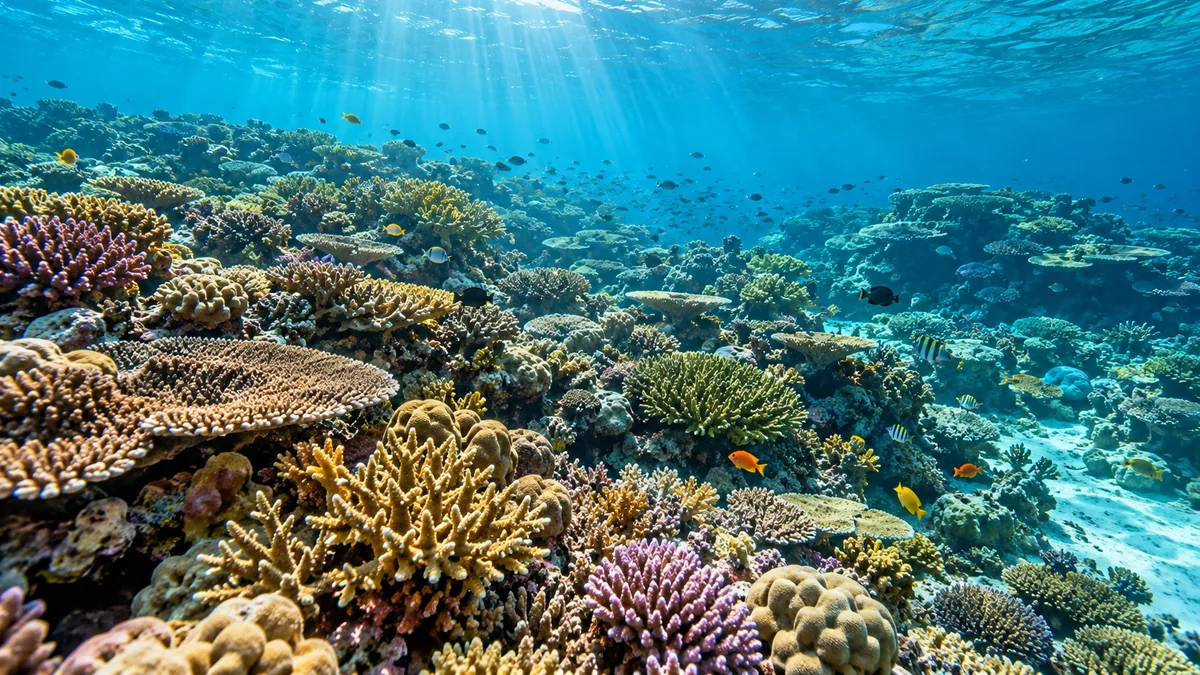
100 reef-bearing countries and territories × 2,850 km² illustrative average reef area ≈ 285,000 km²
Area is not the same as living coral cover
A photograph of a reef shows coral colonies, fish, sand, and open water within a wider reef ecosystem. Our question asks for the mapped area of coral reefs worldwide, expressed in square kilometres. It is not a count of individual coral animals, a measure of healthy living coral surface, or the total area of all tropical seas. A reef can remain mapped as a reef even when its living coral cover is damaged or reduced.
UN Environment Programme material gives a broad global reef extent near 285,000 square kilometres, found across more than one hundred countries and territories. Different mapping methods can produce different area estimates because reef boundaries, resolution, and habitat definitions vary. The number is a useful scale, not a universal boundary traced to the last square metre. We will approach it through a country-count model and then test the result against the enormous area of the oceans.
Count reef-bearing places, then average
Round the number of reef-bearing countries and territories to one hundred. Assign an illustrative average of 2,850 square kilometres of mapped reef to each. Multiplying gives 285,000 square kilometres. The average is deliberately fictional: reefs are highly uneven, and some countries have vastly more reef area than others. The model is not saying every coastline contains an equal patch. It shows how a geographically scattered habitat can sum to a substantial global footprint.
If the average were 1,500 square kilometres, the result would be 150,000. At 4,000 it would be 400,000. That broad range reflects the weakness of a single average over very unequal places. The UNEP benchmark sits within it. For conservation planning, a better model would sum mapped reef polygons by region rather than rely on our simple product, but the product makes the scale and its controlling assumption easy to challenge.
Check against the ocean itself
Earth has roughly 361 million square kilometres of ocean surface. Divide 285,000 by 361 million and obtain about 0.00079, or 0.079 percent. That is below one tenth of one percent, consistent with UNEP descriptions of reefs as occupying less than 0.1 percent of ocean area. This is an independent denominator check: if the country model had produced hundreds of millions of square kilometres, we would know it had confused reef habitat with tropical ocean.
A second shape check imagines a single square of reef with the same total area. The square root of 285,000 is about 534, so the square would be roughly 534 kilometres on each side. Actual reefs are fragmented along coasts and islands, not one compact square. The exercise turns an abstract area into a physical scale and reminds us why a global total cannot reveal how connected or accessible the habitat really is.
The map is not a health score
UNEP-supported monitoring has documented losses of living coral cover over time. That does not automatically mean that every square kilometre of reef habitat disappears from a mapped global extent at the same rate. Living cover can fall within a reef whose geomorphological outline remains. Mixing these two measurements could turn a report of coral loss into an incorrect claim that the same percentage of reef area vanished. The distinction matters for honest communication.
Reef location also matters. Warm-water reefs cluster in tropical and subtropical shallow seas with enough light. The same area of water in a deep, cold basin would not be a plausible reef site. An ocean-wide average makes the habitat seem almost invisible, but local reef zones can be dense and biologically important. The Fermi estimate counts area, not biodiversity, fisheries production, coastline protection, or the number of people who depend on reefs.
Try a regional estimate
Suppose an island chain has 120 separate reef systems, each averaging two square kilometres of mapped habitat. The product is 240 square kilometres. If detailed mapping reveals that half of those systems are actually larger fringing reefs averaging five square kilometres, the estimate changes substantially. Segmenting by reef type can improve the model, but only if the classifications and average areas are based on observations rather than intuition alone.
The worldwide answer is roughly 285,000 square kilometres of reef habitat, with mapping uncertainty and definitions attached. Multiplying reef-bearing places by an illustrative average gives a first pass; comparing with total ocean area guards against a scale error. The surprising lesson is that a habitat can occupy a tiny fraction of the planet while remaining central to many coastal ecosystems and communities.