World in numbers · Number story 200
How many container units do global ports handle in a year?
Port activity is measured in handling events, so the same box can contribute more than once to the global total.
7 minute read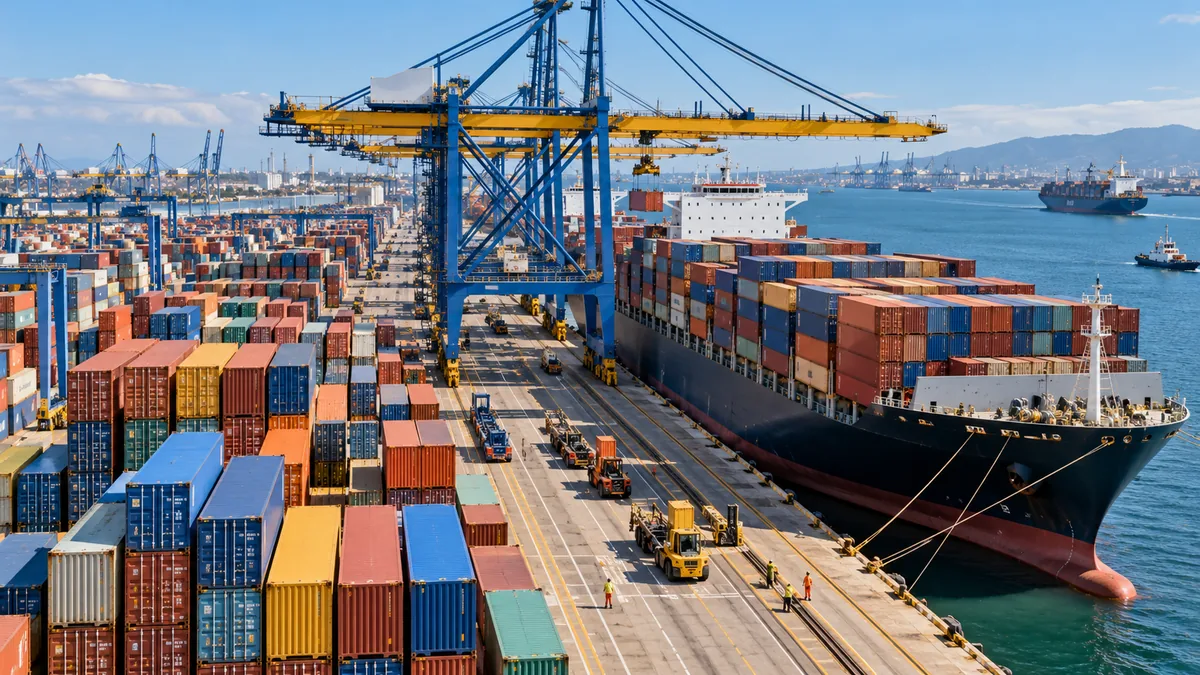
2.5 million TEUs handled/day × 365 days ≈ 913 million TEUs/year, rounded to 920 million
A container unit is not a unique box
A port crane lifts a container from a ship onto a quay. It may later lift that same container onto another vessel. Both activities can appear in throughput accounting. Our question asks how many twenty-foot-equivalent units, or TEUs, ports worldwide handled in 2024. A TEU is a standardized capacity unit equivalent to a twenty-foot container. A forty-foot box commonly represents two TEUs. The annual throughput is not the number of distinct physical containers on Earth or the tonnage of cargo inside them.
UN Trade and Development reports that ports handled about 920 million TEUs worldwide in 2024. This includes loads and discharges across many ports, and a transshipped box can be handled repeatedly along one journey. We will estimate the annual scale from a daily port-activity rate, then ask whether the implied regional distribution and physical movements are plausible. Keeping the event definition attached is the best defense against a spectacular but incorrect interpretation of the number.
From an average day to a year
Start with an illustrative average of 2.5 million TEUs handled across the world each day. Multiply by 365 and obtain 912.5 million TEUs, close to the UNCTAD figure of 920 million after rounding. The daily anchor is a model input chosen to test scale, not a claim that exactly the same volume moves every calendar day. Ports experience weather closures, labor schedules, holidays, and seasonal trade peaks, while the global daily total smooths many local interruptions.
The calculation is sensitive to the daily rate. Two million TEUs per day would give 730 million annually; three million would give nearly 1.1 billion. Both are within the same rough magnitude, but the published benchmark favors a value near 2.5 million. The 2024 date matters because container trade can expand or contract. It would be misleading to use the 2024 annual total as an exact forecast for every later year.
Check against a regional slice
UNCTAD says ports in developing Asian economies handled about 60 percent of the global 2024 traffic. Sixty percent of 920 million is about 552 million TEUs, leaving roughly 368 million for other regions. That large concentration is plausible given manufacturing networks and major transshipment hubs. It is a composition check on the global number: if one regional category alone were reported at two billion TEUs in the same year and definition, our worldwide estimate would be impossible.
An operational check divides 920 million by 365 to recover about 2.52 million TEUs per day. At a very rough two TEUs per forty-foot-box movement, that is on the order of 1.3 million large-box equivalents daily. Real port traffic includes different box lengths and mixes of full and empty containers; this is not a literal daily lift count. It shows why the worldwide system needs many terminals, cranes, vessels, trucks, and trains rather than a single giant port.
Why handling is not trade volume
A container may be loaded at an origin port, discharged at a transshipment hub, loaded again, and unloaded at its final destination. Each step contributes to port throughput even though there is only one shipment. Empty repositioning adds activity too. Conversely, some cargo moves as bulk freight or on other modes and never enters a container terminal. Dividing annual TEUs by world population would give an accounting rate, not a personal consumption measure.
UNCTAD defines the standardized unit so differently sized boxes can be aggregated. This does not tell us whether a box is full, how heavy it is, or how valuable its cargo is. A fashion shipment and a box of low-value materials may each add the same TEU count. If the question changes from port handling to traded goods by weight or value, a different dataset and model are required. Precision about the denominator is more important than extra decimal places.
Estimate a smaller port
Imagine a port with 2,000 TEUs handled on an average operating day and activity on 350 days in a year. Multiplication yields 700,000 TEUs annually. If half of its handling is transshipment, that does not mean 350,000 unique imported containers arrived for local use; boxes can enter and leave several times. A local planner would check vessel calls, berth productivity, terminal hours, and container sizes before treating the estimate as a capacity decision.
The Fermi lesson is to count the action actually reported. About 920 million TEUs in 2024 means container capacity units handled at ports, not 920 million unique boxes. The daily multiplication gives a fast first answer, while regional share and box-equivalent checks make the result tangible. Once the category is stable, the model can be updated with a new year of UNCTAD data without changing its underlying logic.


