Energy & planet · Number story 199
How much ice did glaciers lose worldwide in one year?
A modest average thinning spread across an enormous ice area becomes hundreds of billions of tonnes.
7 minute read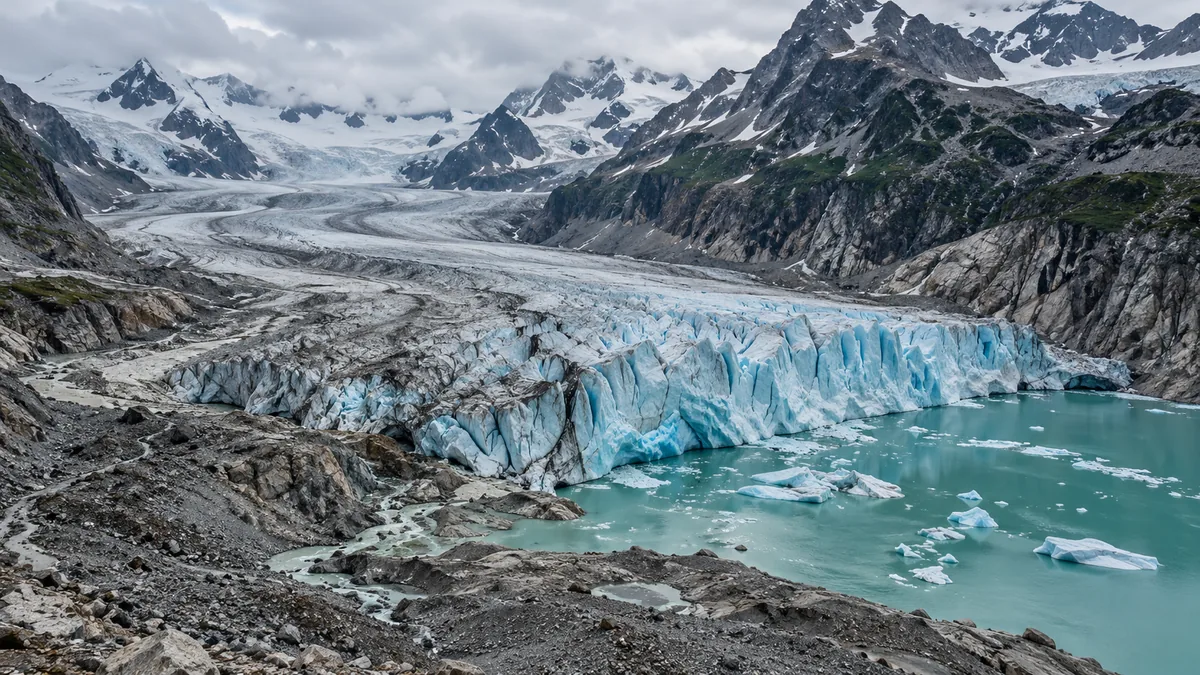
700,000 km² glacier area × 0.64 m assumed water-equivalent loss × 1 billion tonnes per km³ ≈ 450 billion tonnes
Specify the ice and the year
A glacier can advance in one valley while ice thins elsewhere. The question here is global net glacier mass loss during the 2024 hydrological year, measured as the mass difference after snowfall gains and melt losses are both considered. It excludes the continental ice sheets of Greenland and Antarctica, which are normally reported separately. It is not the gross amount of water that ran off glaciers in a warm afternoon. The time window and the category of ice determine which number belongs in the answer.
The World Meteorological Organization, drawing on the World Glacier Monitoring Service, reported about 450 billion tonnes of glacier mass loss for the 2024 hydrological year. We will reconstruct the order of magnitude with an area-times-thinning model. Both area and average thinning will be rounded illustrative inputs. The published result is an observationally compiled estimate, while our multiplication is a transparent explanation of how such a large mass can arise.
Area times water-equivalent thickness
WMO puts worldwide glacier area at roughly 700,000 square kilometres. Imagine net thinning equivalent to 0.64 metres of liquid water over that area during the year. Convert 0.64 metres to 0.00064 kilometres. Multiplying area by depth yields 448 cubic kilometres of water equivalent. One cubic kilometre of water contains roughly a billion tonnes, so the result is about 450 billion tonnes of lost mass. Water equivalent avoids confusing the density of snow, glacier ice, and liquid water.
The area is a reported global approximation and the thickness is an illustrative model assumption, not a replacement for a glacier inventory. Change mean thinning to 0.4 metres and the model produces 280 billion tonnes; at 0.8 metres it produces 560 billion. A regional glacier can gain mass even when the global sum is negative. Averaging over very different mountain climates hides the spatial pattern, but it makes the global mass scale understandable without simulating every glacier separately.
Check the mass using a different shape
WMO estimates average glacier mass loss of about 273 billion tonnes a year over 2000–2023. The 2024 estimate of 450 billion is larger, but it is of the same hundreds-of-billions order, rather than a few million or many trillions. This check uses a different time window, so it does not validate the exact 2024 total. It does show that the area-times-thinning model landed on a credible global mass scale.
Another independent check comes from sea-level equivalent. WMO reported cumulative glacier losses of more than 9,000 billion tonnes since 1975, corresponding to about 25 millimetres of sea-level rise. Dividing 9,000 by 25 gives around 360 billion tonnes per millimetre. A 450-billion-tonne annual loss would thus be roughly 1.25 millimetres of sea-level equivalent. That comparison checks the mass scale, although real sea level also responds to ice sheets, ocean heat, and other contributions.
Do not turn the number into a forecast
Glacier mass balance varies with winter snowfall, summer temperature, wind, and local geography. The 2024 figure is one year, not a rule that exactly 450 billion tonnes must disappear every future year. WMO described the 2022–2024 period as exceptionally negative overall. Using one dramatic year to project the date every glacier vanishes would ignore different initial sizes and climate trajectories. A forecast would need region-specific measurements and physical modeling.
The global mass total also says little about local water availability on its own. Meltwater may reach communities during one season, be stored in lakes, or flow to a distant river. Short-term increased runoff can coexist with long-term loss of natural ice storage. Distinguish gross melt, net annual balance, river flow, and sea-level contribution. Those are related but not equal quantities. Clear units make the differences visible rather than letting a large number carry every interpretation.
Try a single glacier
Consider a glacier covering ten square kilometres that loses an average of one metre of water equivalent over a year. Area times depth is 0.01 cubic kilometres, or ten million cubic metres of water equivalent. At about one tonne per cubic metre, that is ten million tonnes. If the glacier gained enough snowfall to offset half the melt, the net loss would be smaller. The exercise shows why the word net is not optional.
Scaling that small example to hundreds of thousands of square kilometres turns local thinning into a global mass. The Fermi model is deliberately simple, but its units are rigorous: square kilometres times kilometres gives cubic kilometres, and water density turns volume into tonnes. The WMO benchmark checks the answer; the shape and sea-level comparisons challenge it from other angles. What remains uncertain is not whether the order is large, but how the loss is distributed and how it changes.