Movement · Number story 195
How many fishing vessels are there worldwide?
Begin with people who fish for a living, then test the boat count against motorized and small-scale fleets.
7 minute read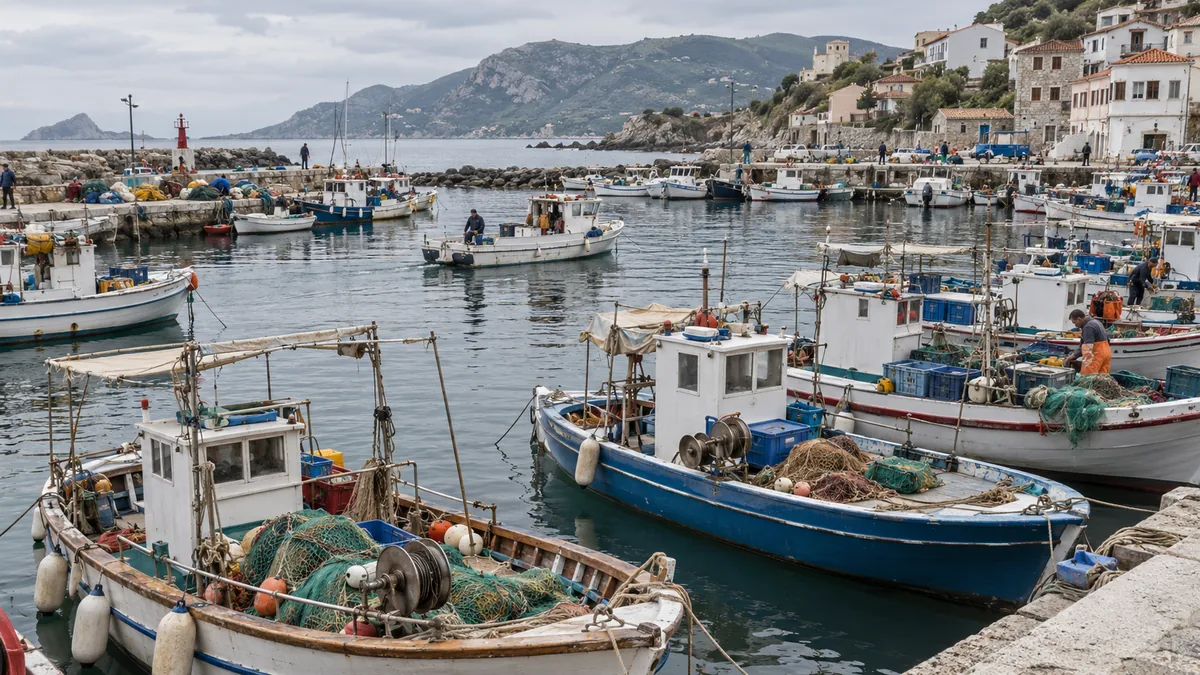
33.6 million people working aboard fishing vessels ÷ 7 people per vessel-equivalent ≈ 4.8 million vessels
Think beyond the industrial trawler
The phrase fishing fleet can conjure a small number of large steel ships. In reality, the world includes countless small motorboats and non-motorized craft used in capture fisheries. Our question counts distinct fishing vessels in operation or recorded in the fleet around a recent year. It does not count recreational boats, aquaculture pens, fish caught, or vessel-days at sea. A boat tied to a dock between trips is still one vessel in the fleet; a boat making hundreds of trips is not hundreds of boats.
The Food and Agriculture Organization has estimated about 4.9 million fishing vessels for 2022, while a later FAO account places the 2024 world fleet near 4.7 million. We will aim for the order of magnitude of five million rather than pretend that reporting changes, licensing differences, and fleet turnover allow a perfect current tally. The key intuition is that small craft dominate the number of hulls even when big ships dominate photographs or parts of the catch.
Build a people-to-vessels model
FAO states that roughly 33.6 million fishers work aboard capture-fishing vessels. Suppose there are seven distinct people associated with each vessel in an effective annual count. Divide 33.6 million by seven and obtain about 4.8 million vessels. Seven is a modeling assumption, not a universal crew size. A small boat may have one or two people aboard at a time, while a larger vessel may carry many; workers can also alternate shifts or use more than one boat over a year.
That is why we call it an effective annual ratio rather than a photograph of seven people standing on every deck. If we assumed five fishers per vessel, the answer would rise toward 6.7 million; at ten, it would fall to 3.4 million. The range spans several million but stays far below hundreds of millions. It is a useful first pass that can be checked against fleet composition instead of being treated as a precise conversion from workers to hulls.
Check with motorization
FAO reports that roughly two thirds of the global fleet, about 3.3 million vessels in its 2022 accounting, are motorized. If our 4.8-million-vessel answer is correct, two thirds would be about 3.2 million motorized hulls. That is close to the FAO figure and leaves around 1.6 million craft without engines. This is a separate composition check: it asks whether the proposed total can be split into plausible equipment categories rather than merely repeating the people-to-vessel division.
A second scale check comes from size. FAO says the overwhelming majority of fishing vessels are shorter than 24 metres, and many motorized boats are shorter than 12 metres. A model built only from large industrial ships would miss most vessels by count. Conversely, counting every recreational dinghy would inflate the commercial capture fleet. The small-boat prevalence is essential to making a multi-million answer believable.
Why a global fleet count is difficult
Large commercial vessels are more likely to have formal registration and electronic records. Small-scale or non-motorized craft may be recorded through local surveys, licensing systems, or estimates, and coverage can vary. One boat can be inactive in a given month yet remain part of a fleet inventory. Boats may be replaced, shared, or moved between regions. FAO has revised past fleet estimates as country data improve, which helps explain why a recent 4.7-million figure and an earlier 4.9-million figure should not be read as exact yearly departures from a flawless global register.
The fleet is also geographically uneven. FAO places around seventy percent of fishing vessels in Asia, with many more in Africa and smaller shares elsewhere. That does not mean all regions catch fish with the same vessel size or effort. Boat count alone cannot tell us total catch, fuel use, fishing pressure, or safety conditions. Those require days at sea, gear, power, location, and stock information. Our estimate answers how many hulls there are, not how much they do.
Try a coastal-region calculation
Imagine a coastal region with 70,000 people working aboard capture-fishing boats. If the effective ratio were seven fishers per vessel, it would have about 10,000 boats. Check that number against harbors and landing sites: one hundred sites averaging one hundred craft would match it. If local observation suggests only twenty landing sites, the assumed ratio or site count needs revision. This local infrastructure check can uncover a global-style estimate that looks plausible only because its denominator is abstract.
The Fermi habit is to separate people, boats, and fishing effort. FAO provides useful primary benchmarks; the seven-person conversion is the deliberately uncertain step. A rounded five-million-vessel answer is not a census of every harbor. It is a transparent, testable model that recognizes the enormous contribution of small craft and stays honest about incomplete registration and changing definitions.