Energy & planet · Number story 194
How much ocean water evaporates in a day?
An invisible film lifted from a vast surface becomes more than a thousand cubic kilometres of water each day.
7 minute read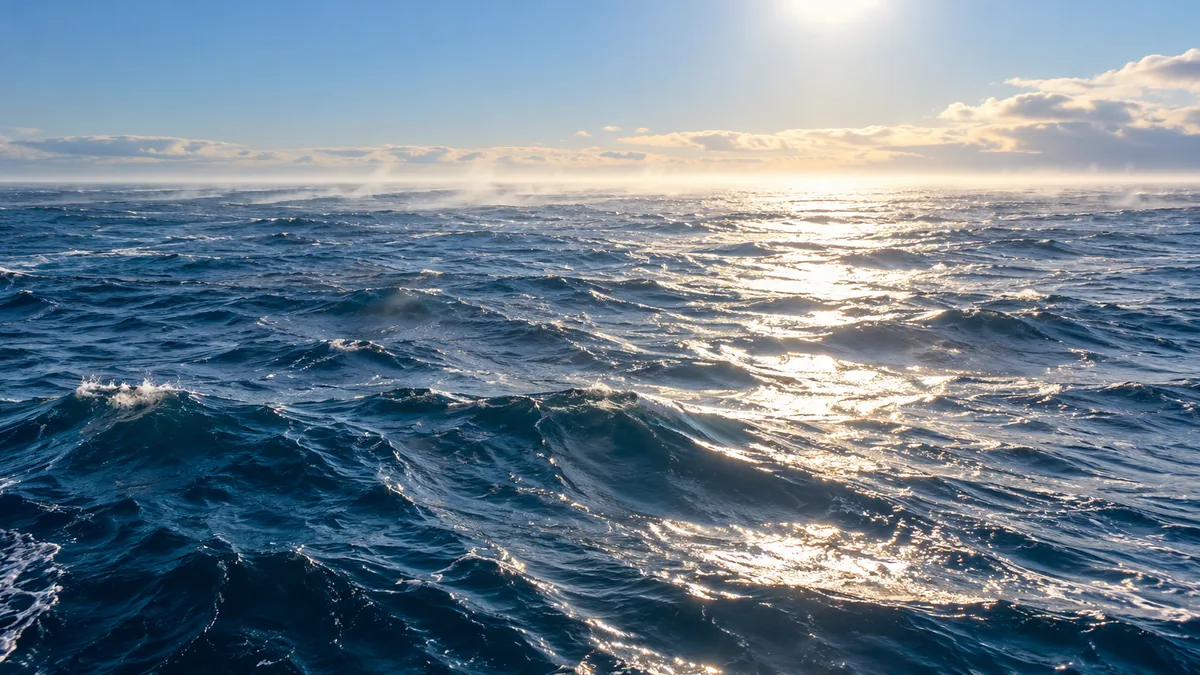
361 million km² of ocean × 0.00125 km of evaporation/year ÷ 365 ≈ 1,200 km³/day
An invisible movement of water
Ocean evaporation rarely looks like steam rising from a kettle. Individual water molecules leave the surface, and wind carries water vapour away. Across an entire ocean the transfer is immense even though no single wave visibly shrinks. Our question counts the volume of liquid ocean water that becomes vapour during an average day, expressed as equivalent cubic kilometres of liquid water. It does not count rain falling back into the ocean or the net change in sea level. Evaporation and precipitation are separate, very large opposing flows.
A NASA-led synthesis of satellite and other observations estimated about 449,500 cubic kilometres evaporating from the oceans in a year. Divide by 365 and the mean is about 1,230 cubic kilometres each day. We will reconstruct that scale from surface area multiplied by a shallow annual layer. The aim is not to suggest that every part of the sea evaporates at the same rate. It is to see how a layer barely more than a metre thick over a year can become a staggering global daily flow.
Area times depth gives volume
Use a rounded ocean area of 361 million square kilometres. Assume annual evaporation equivalent to a water layer 1.25 metres deep across that area. Convert depth to kilometres before multiplying: 1.25 metres is 0.00125 kilometres. Area times depth is about 451,000 cubic kilometres per year. Divide by 365 to get roughly 1,236 cubic kilometres per day, which we round to 1,200. The 1.25-metre layer is an illustrative global mean chosen to be tested against NASA observations, not a local measured rate.
Units are everything here. Multiplying square kilometres by metres without conversion leaves an unlabeled quantity that can conceal a thousand-fold mistake. If the mean layer were one metre, the daily result would be about 990 cubic kilometres. At 1.5 metres, it would be about 1,480. The uncertainty in a global mean depth matters more than whether a particular calendar year has one extra day. Warm tropical seas, cold high latitudes, dry winds, and humid air all have different local evaporation.
Check against the atmosphere
The U.S. Geological Survey estimates roughly 12,900 cubic kilometres of water in the atmosphere at one time and describes a water molecule spending about ten days there on average. Divide the atmospheric store by ten days: an approximate turnover of 1,290 cubic kilometres per day. That is the right order of magnitude for the ocean contribution alone. The comparison is not exact because land evaporation and plant transpiration also feed the atmosphere, and residence times vary. It is a genuinely different physical lens on the ocean-area calculation.
The NASA synthesis also estimated about 70,600 cubic kilometres of annual evaporation from land. Divide that by 365 and get about 190 cubic kilometres per day. Ocean and land together would be around 1,420 cubic kilometres daily. A 12,900-cubic-kilometre atmospheric store divided by that flow gives a turnover near nine days, reasonably close to the USGS ten-day rule of thumb. That agreement is more informative than a string of precise digits after the 1,200 figure.
Why the ocean does not simply vanish
NASA estimated about 403,500 cubic kilometres of precipitation falling over the oceans each year. Much evaporated ocean water therefore returns directly to the sea. The difference between ocean evaporation and ocean precipitation is replenished through water carried from land by rivers and other flows. Calling the full evaporation figure a loss of ocean volume would confuse gross exchange with net storage change. It is similar to mistaking all money paid from an account for the change in its balance while ignoring deposits.
The daily mean is also a calendar abstraction. Sunlight, winds, sea-surface temperature, and humidity shift with season and geography. A local patch of water might evaporate faster or slower than the assumed 1.25-metre annual equivalent. Ocean water that evaporates leaves most salts behind, but that fact does not mean the resulting cloud can be assigned to a particular sea without tracking atmospheric transport.
Make a smaller patch of ocean
Imagine a square of sea one kilometre on each side. At 1.25 metres per year, its annual evaporation is 1.25 million cubic metres, or 0.00125 cubic kilometres. Divide by 365 and the daily liquid-water equivalent is roughly 3,400 cubic metres. That is large for one square kilometre yet tiny against global ocean area. Multiplying the patch result by 361 million patches returns the planetary estimate and exposes the scale factor directly.
This Fermi exercise teaches a useful habit: take a weak-looking local flow, attach the correct area and time units, and then reverse-check it against an independent reservoir or flux. NASA supplies an observational annual benchmark; the atmosphere provides a second scale test. Keep gross evaporation distinct from net ocean change. The number is striking because the ocean is vast, not because a visible curtain of vapour rises from every wave.