World in numbers · Number story 191
How much electronic waste does the world make in a year?
Start with a small annual mass per person, then test the global total against the kinds of equipment being discarded.
7 minute read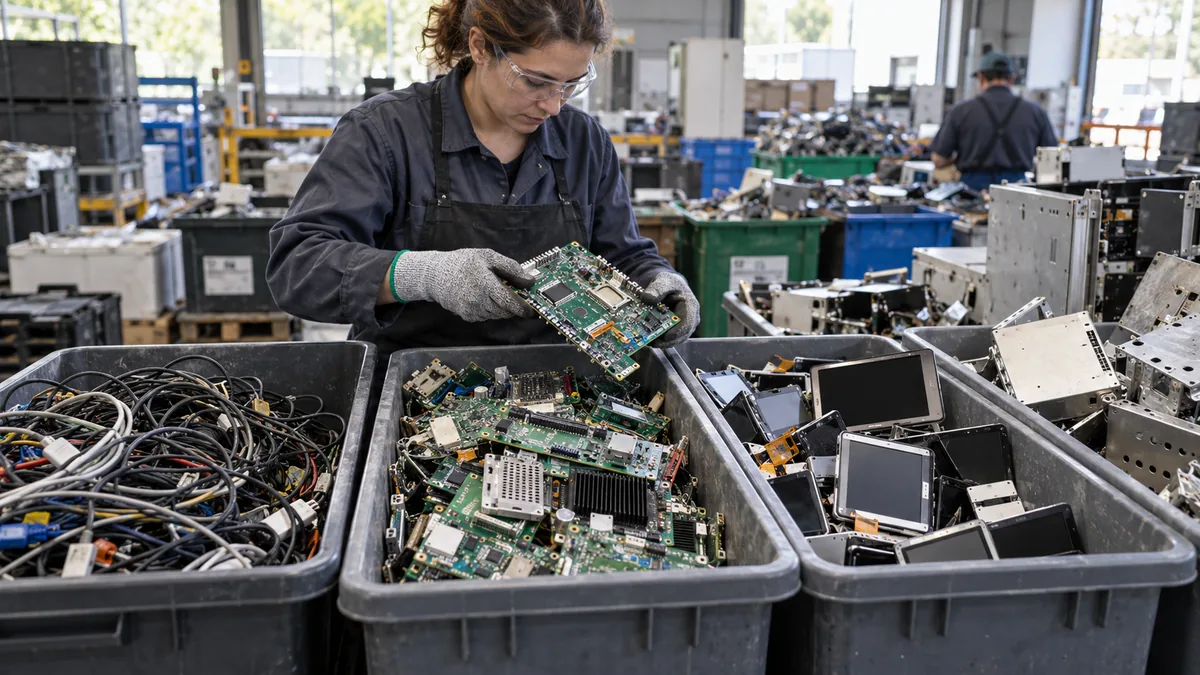
8 billion people × 7.8 kg of e-waste/person/year ÷ 1,000 kg/tonne ≈ 62 million tonnes/year
What belongs in the pile?
A broken phone is the familiar image of electronic waste, but it is far from the whole pile. Refrigerators, lamps, monitors, small appliances, power tools, cables, and computers can all enter the waste stream. We count the mass of discarded electrical and electronic equipment generated in a year, whether or not it was later collected and recycled. We do not count every device sold, nor do we count the same repaired laptop each time it changes hands. The boundary is when equipment becomes waste, not when a household first stops using it.
The ITU and UNITAR Global E-waste Monitor 2024 estimated 62 billion kilograms of electronic waste generated in 2022, equivalent to 62 million tonnes. That is a measurement-and-modeling benchmark assembled across countries, not a real-time weighing of every bin. Our Fermi estimate begins with a person-level average and asks whether a seemingly small mass can plausibly accumulate into tens of millions of tonnes. The answer is yes, but only if we include the heavy equipment that a phone-centered mental picture misses.
Multiply an average by the population
The same ITU report expresses the 2022 total as about 7.8 kilograms per person. Use a rounded world population of eight billion and multiply: 8 billion times 7.8 kilograms is 62.4 billion kilograms. Divide by one thousand to convert kilograms to tonnes, giving about 62 million tonnes. Because both the population and per-person rate are rounded, showing 62.4 as if it were a new precise census would be misleading. The point is the size of the answer and the conversion between kilograms and tonnes.
The 7.8 kilograms is a global accounting average, not a claim that each person discards one similar device every year. Someone may keep a phone for years and then throw away a heavy washing machine. Businesses and institutions also retire equipment. If the effective average were five kilograms, the result would be 40 million tonnes; at ten kilograms it would be 80 million. Those alternatives remain in the tens of millions and show which assumption controls the Fermi model.
Check by equipment category
The Global E-waste Monitor provides another way to inspect the total. Its 2022 categories include about 13.3 million tonnes of temperature-exchange equipment, 5.9 million of screens and monitors, 20.4 million of small equipment, 4.6 million of small IT and telecom equipment, 15.1 million of large equipment, 1.9 million of lamps, and 0.6 million of photovoltaic panels. Add those rounded pieces and obtain about 61.8 million tonnes. Category aggregation is a useful consistency check on the per-person multiplication because it reveals the heavy contributors rather than merely repeating a population average.
This check also corrects intuition. Small IT equipment attracts attention, but large appliances and temperature-exchange equipment together weigh far more. Counting discarded phones without their masses would be a poor route to a global tonnage. The category figures and the published total come from the same monitoring program, so they are not independent field surveys. They do, however, catch a common conceptual error: assuming the global pile is made mostly of lightweight screens and handsets.
Generation is not the same as recycling
ITU reports that 22.3 percent of the 2022 mass was documented as formally collected and recycled in an environmentally sound manner. That is not a statement that all of the remaining material was dumped illegally. Some may be stored in homes, handled informally, exported, or processed through channels with incomplete reporting. Our 62-million-tonne number is waste generated, not a formal-recycling total. Multiplying it by 22.3 percent yields roughly 13.8 million tonnes documented in the formal channel, a distinctly different quantity.
A local estimate would need more than population. Regional incomes, appliance ownership, electricity access, product lifetimes, repair markets, and collection systems alter both the amount generated and how much is recorded. A heavy refrigerator can outweigh many handsets, while a device repaired and reused postpones its waste date. These differences are why a per-capita average is a starting anchor for world scale, not a municipal recycling plan.
Try a second unit
Divide 62 million tonnes by 365 and the annual total becomes roughly 170,000 tonnes each day. At an illustrative forty tonnes per truck, that is about 4,250 loaded truck equivalents daily. Real electronic waste moves in mixed loads and by many routes, so the trucks are only a visualization. If the calculation had produced four million fully loaded trucks every day, the per-person arithmetic would deserve another look. Reverse conversion is a quick guard against a misplaced thousand.
The lesson is to keep an eye on both mass and composition. A global total becomes understandable by multiplying a modest per-person figure, but the category check explains why the mass is plausible. State whether you mean generated waste, formally collected waste, or material actually recycled. Those are separate stages. A useful estimate lets a reader replace any assumption without losing track of what is being counted.


