World in numbers · Number story 189
How much food waste does the world generate in a day?
A billion-tonne annual total becomes a daily flow large enough to demand careful definitions and a second check.
7 minute read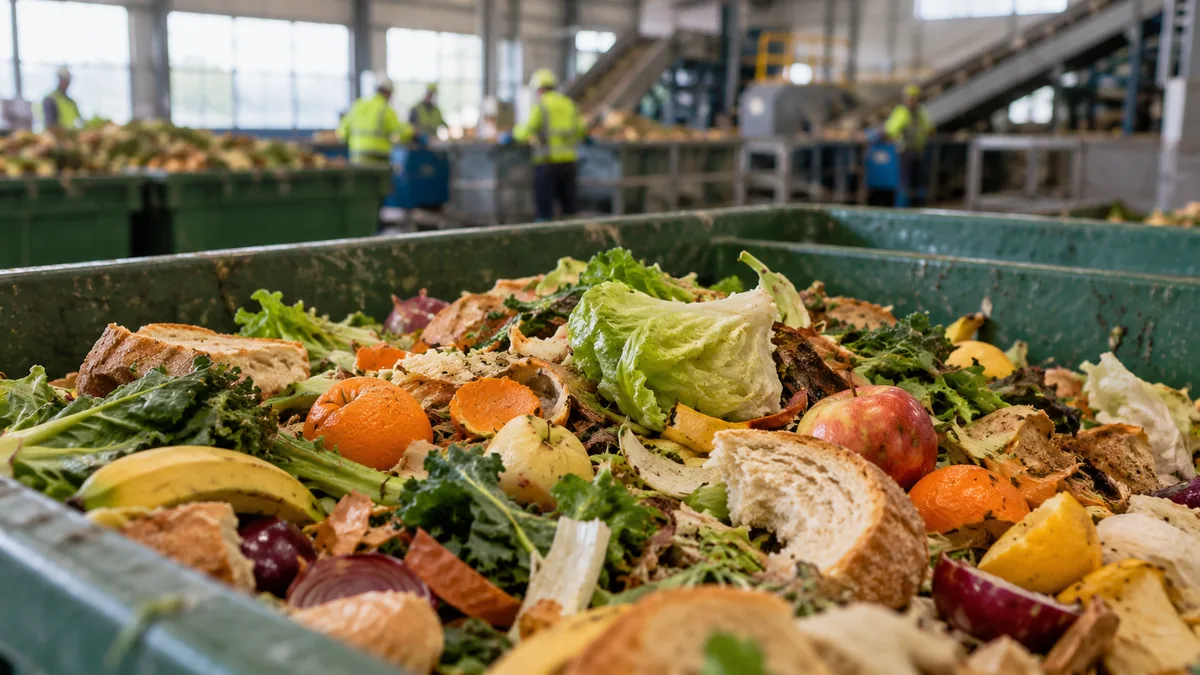
1.05 billion tonnes of retail, food-service and household food waste/year ÷ 365 ≈ 2.9 million tonnes/day
Which food is inside the number?
A household bin contains peels, stale bread, unfinished meals, and sometimes food that was never opened. Restaurants and shops have their own discarded food. The United Nations Environment Programme Food Waste Index measures waste at the retail, food-service, and household stages, including inedible parts such as bones and peels. That is the boundary of our question. It is not the same as all crops lost on farms, food lost during transport and storage before retail, or only edible meals that could have been eaten.
For 2022, UNEP estimated 1.05 billion tonnes of food waste in those consumer-facing stages. We want a daily average. The arithmetic is straightforward, but the conceptual boundary is not: changing the definition changes the answer far more than choosing 365 instead of 366 days. A practical working value is about 2.9 million tonnes a day. That is a modeled daily mean from an annual study, not a measurement of what was discarded on any particular Tuesday.
Divide carefully and keep the units
Write the annual total as 1,050 million tonnes. Divide by 365 days and obtain approximately 2.88 million tonnes per day. Rounding to 2.9 million is honest because the underlying global estimate joins many national measurements and modeled gaps. The figure includes food from households, food service, and retail. UNEP attributes around 60 percent of the annual total to households, 28 percent to food services, and 12 percent to retail. Those shares describe where waste occurs, not whether each discarded item was edible.
One common error is to call the same number food loss across the whole supply chain. UNEP explicitly separates this consumer-stage waste from the additional food loss that the Food and Agriculture Organization estimates between harvest and retail. Another error is to compare tonnes of wet food scraps directly with a count of meals. Moisture, bones, peels, plate size, and waste composition differ. The number is a mass flow, not a tally of wasted dinners.
Use people as an independent scale check
UNEP also reports approximately 132 kilograms of consumer-stage food waste per person per year. Multiply that rounded per-capita amount by a world population of about eight billion: 1.056 trillion kilograms, or 1.056 billion tonnes annually. Divide by 365 and the implied daily amount is near 2.9 million tonnes, matching the direct conversion. These figures originate from the same UNEP accounting system, so they are a consistency check rather than a completely independent census. Still, they expose a thousand-fold unit error immediately.
The per-person framing makes the total less abstract. One hundred thirty-two kilograms per year is about 360 grams per person per day on a global accounting average. That does not mean every individual personally throws away that amount at home; restaurant and retail waste are allocated across the population, and real circumstances vary widely. The average is useful for scale, not for blaming a particular household or predicting the contents of a city bin.
Could the physical system carry it?
Another reasonableness test turns the daily mass into transport. At an illustrative twenty tonnes of food waste per fully loaded truck, 2.9 million tonnes would fill about 145,000 truckloads each day. The real world does not move all food waste in identical trucks: some is composted locally, some enters mixed rubbish, and collection vehicles rarely carry a neat twenty-tonne load of only food. The calculation is a scale picture, not a logistics inventory. It does show why waste treatment is an infrastructure question, not only an individual habit.
Seasonal effects make daily flows variable. Festivals, harvests, tourist peaks, weather damage, and retail ordering practices alter what is discarded. Global averages smooth those peaks across regions. A local authority should start from weighed collection streams and account for waste that never enters formal collection. It should also distinguish avoidable edible waste from unavoidable scraps if it wants to design prevention rather than simply expand treatment capacity.
Try a local calculation
For a city of one million people, take the broad 132-kilogram-per-person annual figure as a starting anchor. That implies 132,000 tonnes a year or about 360 tonnes a day. Then ask whether the city differs from the global average in income, food-service activity, tourism, rural markets, and waste collection coverage. A city with 60 percent of the global rate would be near 215 tonnes a day; one at 150 percent would be near 540 tonnes. The range is more useful for planning than a copied global decimal.
The Fermi lesson is to name the stage of the food system, choose the mass unit, and convert time explicitly. A big annual statistic can be made intuitive by dividing into people, days, or truckloads, but each conversion answers a different question. The UNEP benchmark supports a daily scale of millions of tonnes. The remaining work is deciding what portion is preventable, where it arises, and how a local system could reduce it.


