World in numbers · Number story 180
How much space dust reaches the ground each year?
A rain of microscopic particles becomes thousands of tonnes only when summed across the whole planet.
7 minute read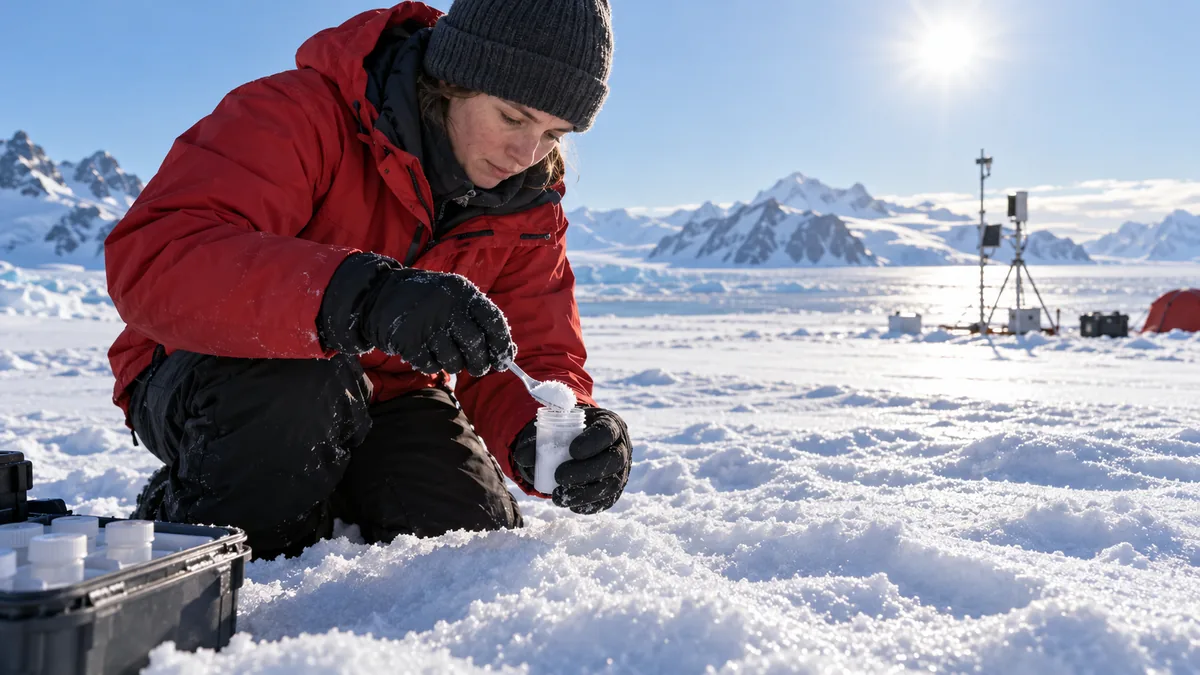
15,000 tonnes of small incoming dust/year × 35% surviving as ground-reaching particles ≈ 5,200 tonnes/year
The boundary is the surface, not the sky
On a clear night, a bright meteor is memorable. Most extraterrestrial material arriving at Earth is much smaller and less theatrical. Some dust grains heat, melt, and vaporize in the atmosphere; others survive as micrometeorites that eventually settle on land or sea. Our question counts the mass of tiny extraterrestrial particles that reaches Earth's surface in a year, not all material approaching the upper atmosphere and not the number of visible shooting stars. A useful working answer is about 5,200 tonnes annually.
That may sound heavy for particles that are individually almost invisible. The crucial multiplier is surface area. A trace amount deposited on each square metre can add up when the receiving surface is an entire planet. Scientists cannot simply put a bucket under the sky and weigh all the incoming dust. They infer global flux from carefully collected samples, particle sizes, accumulation time, and assumptions about how representative a sampling site is.
Separate incoming mass from surviving mass
A research team collecting micrometeorites from ultra-clean Antarctic snow at Dome C estimated roughly 15,000 tonnes of relevant dust mass before atmospheric entry and about 5,200 tonnes of micrometeorites reaching the ground annually. Dividing 5,200 by 15,000 gives approximately 35 percent surviving in that modeled particle population. For a Fermi reconstruction, take 15,000 incoming tonnes and multiply by 0.35. The result is 5,250 tonnes, which we round to 5,200.
The survival fraction is not a universal law for all space rocks. Particle size, speed, composition, and entry angle affect heating and fragmentation. The Dome C work focuses on a measured micrometeorite population and then extrapolates; it does not weigh every grain that arrives. Other studies of different size ranges or long time periods can yield different totals. The model is therefore a way to explain a published estimate, not a claim that any extraterrestrial particle has exactly a 35-percent chance of surviving.
Check against a daily atmospheric flow
Divide 5,200 tonnes by 365 and the implied ground-reaching flow is about 14 tonnes a day. NASA describes a separate model suggesting around 25 tonnes of extraterrestrial material making its way toward Earth daily. That is about 9,000 tonnes over a year. A ground-surviving small-particle estimate lower than an incoming atmospheric estimate is physically sensible: much material is altered or lost before it reaches the surface. The two sources do not define identical size populations, so their numbers should be compared for scale rather than treated as a precise subtraction exercise.
A second geometric check uses Earth's roughly 510 million square kilometres of surface. Spread 5.2 billion kilograms across that area and the average is about ten milligrams per square metre per year. Ten milligrams is a barely noticeable amount in one place, yet multiplying it by hundreds of trillions of square metres produces thousands of tonnes. This reverse division makes the large global total compatible with everyday experience: most people never notice a layer of space dust accumulating.
Why Antarctic snow is informative but imperfect
Remote polar snow can be unusually useful because it contains fewer local industrial and soil particles than many inhabited places. Researchers can melt carefully dated layers, filter the water, and identify microscopic extraterrestrial grains. But extrapolating one clean site to the globe requires assumptions about atmospheric transport, deposition, preservation, and contamination. Wind can move particles after landing, and an ocean sample has different collection problems. The method is careful measurement combined with a model, not a literal planet-wide weighing.
There is also a terminology trap. Meteoroids are particles in space; meteors are luminous events during atmospheric entry; meteorites are material that survives to reach the ground. A particle can change category as it travels. Counting the flashes seen by observers would miss most microscopic incoming material and would overrepresent bright events. This article asks for mass at the surface, so the surviving micrometeorite category is the one we need.
Try the planet-wide multiplication
Start with a hypothetical deposition rate of five milligrams per square metre per year and multiply it by 510 trillion square metres of planetary surface. The result is about 2,550 tonnes. Double the local rate to ten milligrams and you reach about 5,100 tonnes. That two-step exercise does not replace the Antarctic research, but it shows how sensitive a global total is to a tiny measured local flux. Be careful to convert square kilometres into square metres by multiplying by one million.
The interesting lesson is that the atmosphere filters a continuous stream of small extraterrestrial material, while the surface quietly records what survives. A rounded 5,200-tonne annual estimate is striking, but the boundary and measurement method are more important than the final digits. State whether you mean incoming dust or ground-reaching micrometeorites, keep the size range in mind, and check the global answer by reversing it into a local amount.


