World in numbers · Number story 179
How many tires reach the end of the road each year?
Vehicle stock and replacement intervals lead to a billion-tire problem, with mass as a second check.
7 minute read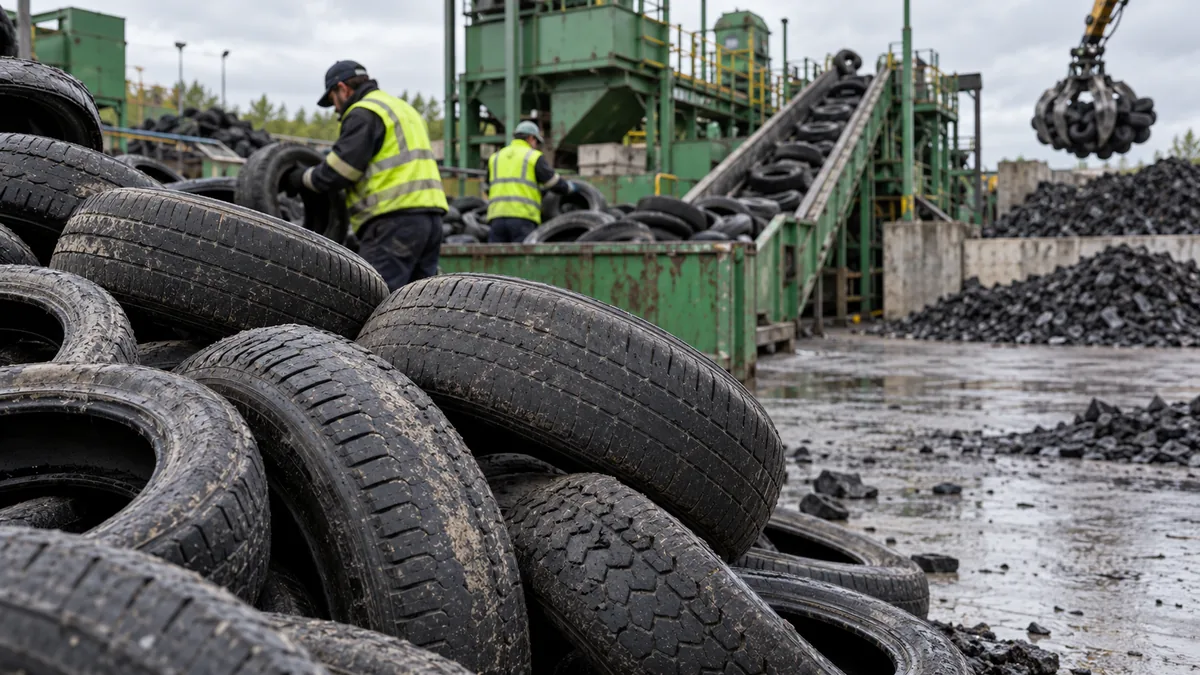
1.25 billion four-tire vehicle equivalents × 4 tires ÷ 5-year average life ≈ 1 billion tires/year
Count the tire, not the tire change
A driver may replace two worn tires at one garage visit, while a truck may change many across several axles. We count individual vehicle tires that finish their useful road-service life during one year worldwide. A tire that is removed for temporary storage and later reused is not necessarily at end of life; a tire that is retreaded may continue in service. For this rough exercise, each permanently retired tire enters the count once. The working answer is about one billion tires a year, which the tire industry also uses as a global order-of-magnitude estimate.
The question sounds like a simple vehicle count, but cars, motorcycles, buses, trucks, agricultural machines, and aircraft have very different tire numbers, sizes, and lives. We therefore use a simplified equivalent-vehicle model, then test its output against industry estimates. It should not be read as a precise inventory of every tire disposed of in a particular calendar year.
Build an intentionally simple vehicle model
Imagine 1.25 billion four-tire vehicle equivalents in active road use. The word equivalent signals that we are compressing a complex global fleet into a convenient model, not citing a measured worldwide stock. Four tires each imply five billion tire positions in service. Suppose the average position receives a replacement after five years. Divide five billion by five and obtain one billion tires leaving road service per year. The World Business Council for Sustainable Development Tire Industry Project independently estimates about one billion end-of-life tires annually.
The replacement interval is not universal. A heavily used delivery vehicle can consume tires faster than a rarely driven household car; a large commercial tire may be retreaded, while a punctured tire may leave service early. If the effective interval is four years, the same fleet model yields 1.25 billion; at seven years it yields about 710 million. Vehicle-equivalent stock is just as uncertain. Writing both assumptions explicitly makes the answer easier to challenge than a standalone billion.
Check the count through mass
The WBCSD management framework places the estimated one billion end-of-life tires at about 17 million tonnes. Divide mass by count and the implied average is 17 kilograms per tire. That is heavier than many ordinary passenger-car tires but plausible as a mixed average that includes larger commercial vehicles. This mass-per-item conversion is a different physical lens on the same industry estimate. If our count implied a global average of several hundred kilograms for each tire, the assumed count or mass would need serious review.
The check is not fully independent because both the mass and tire count appear in the same WBCSD source. A stronger local check would weigh a representative mix of actual discarded passenger, truck, bus, and specialty tires and multiply by category counts. The 17-kilogram implied mean is still useful: it reminds us that an item count is not a complete waste-management measure. A billion small tires and a billion mixed tires create very different transport and processing needs.
Why end of life differs from landfill
A tire reaching the end of road use may be collected for material recycling, recovered for energy, retreaded if its casing remains suitable, exported, stored, or illegally dumped. The WBCSD Tire Industry Project discusses those management routes; the one-billion estimate is about tires reaching the end of useful life, not one billion tires sent to landfill. Treating a retirement count as a landfill count would erase the distinction between waste generation and subsequent handling.
The tire also does not disappear when the vehicle is scrapped. A scrapped vehicle may carry old tires that have already been counted as end-of-life items in a local system, or usable tires that enter a second market. Counting replacement purchases and scrapped-vehicle tires without tracking the flow can double-count. For a city-level estimate, it is often better to start with annual tire collections from shops and fleet depots, then separately account for vehicles dismantled.
Make the scale manageable
Divide one billion by 365 and the average is about 2.7 million tires reaching end of road service each day. At four tires per stack, that would be roughly 680,000 four-tire stacks daily. These mental images are not a literal global yard; they help test whether collection and processing are large industrial systems rather than occasional side businesses. They also show why tracking the fate of tires matters even when each individual replacement feels routine.
Try the estimate with a different vehicle fleet and tire lifespan. For a country, use registered vehicles, average tire positions, and annual distance to infer wear rather than copying the global five-year interval. Then compare with local end-of-life collection figures. The Fermi habit is to keep vehicle positions, replacement events, retired tires, and waste destinations separate. A rounded billion can be defensible, but only when the boundary and assumptions travel with it.


