World in numbers · Number story 159
How many times do people wash their hands at home each day?
A soap-and-water model built from household access, with a second check from household routines.
7 minute read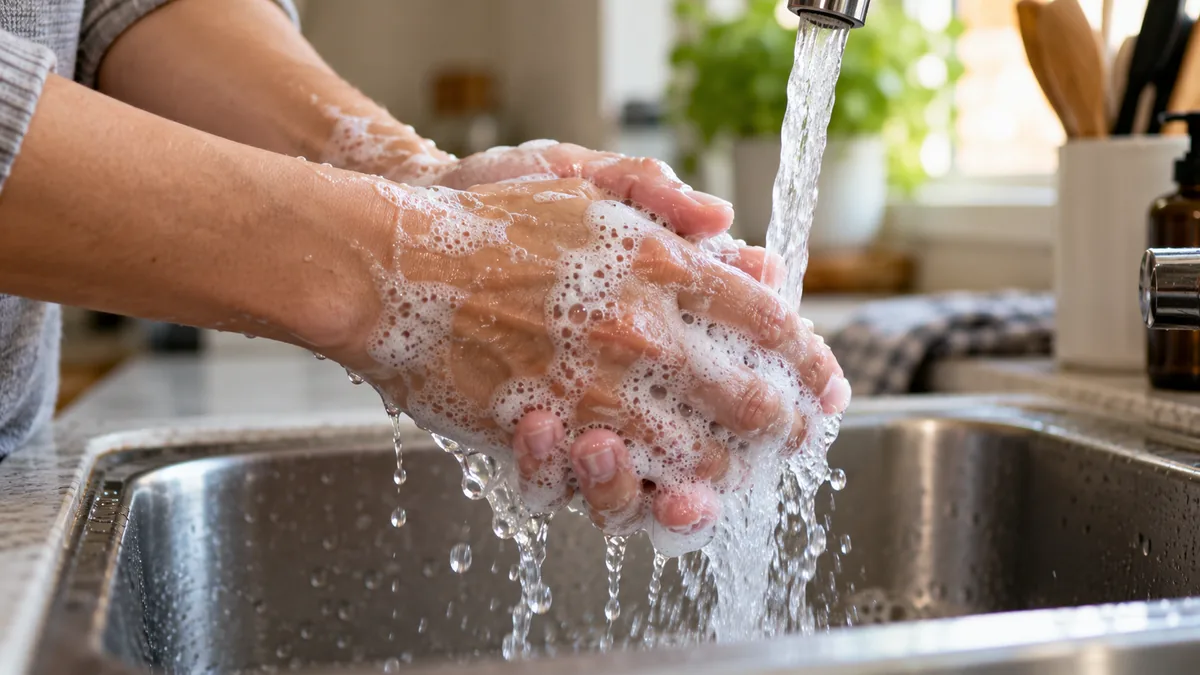
8.2 billion people × 80% basic home hygiene access × 4 washes/person/day ≈ 26 billion episodes/day
Define a wash before counting it
Handwashing feels too ordinary to count, yet its global total could be enormous. We count one episode when a person washes their hands with soap and water at home. A second wash later in the day is another episode. We exclude sanitizer-only use, a quick rinse without soap, and washing at a school or workplace. This narrow definition matters because broad claims about “hand hygiene” may mix different actions and locations. An estimate cannot be evaluated until the event is clear.
The working answer is roughly 26 billion home soap-and-water washes per day. It is not a direct observation of behaviour. We begin with the population who have a basic hygiene facility at home and assume how often they use it. People without that facility may still wash their hands with soap elsewhere or improvise at home; our simple model does not capture every such event. The result is a scale estimate under a defined access model, not a global health surveillance statistic.
Turn access into activity
The WHO and UNICEF Joint Monitoring Programme reports that about 80 percent of the global population had a basic home hygiene service in 2024. In its terminology, that refers to a handwashing facility with soap and water available. On a rounded population of 8.2 billion, this is about 6.6 billion people. If each made an average of four soap-and-water handwashes at home per day, the multiplication gives about 26 billion episodes.
Four is our behavioural assumption, not a figure measured by the access survey. The survey indicates whether a facility and supplies are present, not how many times hands are washed. At two washes per person the result would be about 13 billion; at six it would be close to 39 billion. Household routines, water availability, age, work patterns, and caregiving can all shift the frequency. The source and the assumption must remain separate if readers are to understand the uncertainty.
Check from a household sink
An alternative model starts with roughly two billion households that regularly have soap and water available. If each household averages 13 such washes a day across its members, the result is about 26 billion events. The household stock and frequency are assumptions, not UNICEF measurements. A family home might generate many episodes around cooking and meals; a single-person home might generate fewer. This check asks whether a household-level total could support the population-based result without requiring absurdly frequent trips to a sink.
Reverse division gives another feel for the scale: 26 billion episodes across 8.2 billion people is just over three per person per day, including people who lack access and are modeled as zero. That is lower than the assumed four among people with a basic facility, exactly as it should be. The reverse check catches unit errors, while the household model is the more independent test. Neither route records the real number of handwashing events.
A facility is not the same as a habit
It would be a mistake to call the 80-percent access figure a handwashing rate. A facility may be present but not consistently used, or soap may run out between survey visits. Some people without a fixed household facility may wash with soap using a container of water. An episode at a shared facility may be difficult to assign to one household. Our model compresses those behaviours to make the first estimate possible; it should not be used to rank communities or judge individuals.
The global total also has no automatic relationship to disease burden. Timing and technique matter, and access to clean water and soap is unequally distributed. A public-health programme would need local observations, participation measures, and service reliability, not just our world-scale event count. The Fermi exercise serves a different purpose: it shows how a few daily actions, repeated across billions of people, become a flow in the tens of billions.
Improve the model with observation
Keep a private tally for one day of soap-and-water handwashes at home, noting whether the day is typical. Compare several household types and separate home from work or school. Such a small sample cannot establish a global frequency, but it can expose how much variation hides inside the number four. You could then split the population by household access and by time spent at home before calculating a refined total.
The method is population times access fraction times events per participating person. UNICEF supplies the access benchmark, while frequency remains an explicit assumption. A household-sink route offers a second plausibility check. The honest conclusion is a wide range centered around tens of billions of home handwashing episodes daily, with 26 billion as a transparent working answer. Its strength is not precision; it is that every factor can be questioned.


