World in numbers · Number story 156
How many shipping containers do ports handle each year?
From twenty-foot-equivalent traffic to physical moves, with a check from daily crane work.
7 minute read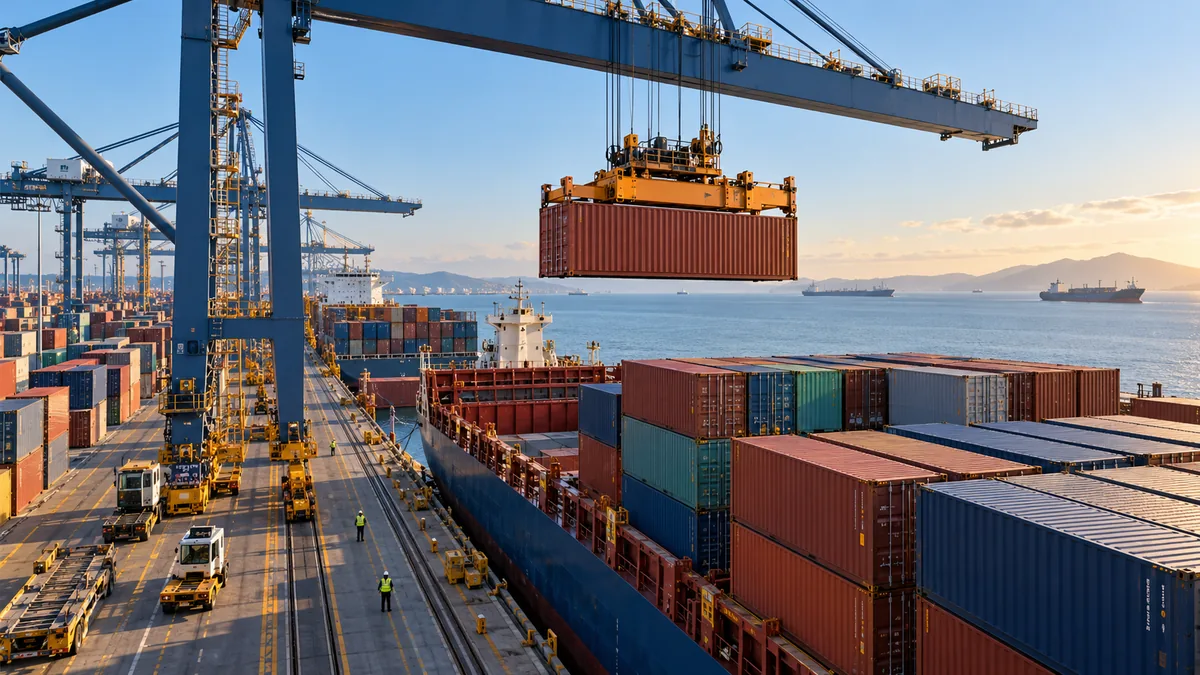
920 million TEU/year ÷ 1.5 TEU per handled container ≈ 610 million port container moves/year
A box can be handled more than once
A container on a ship is easy to recognize; a global count of container activity is less straightforward. We want physical container handling events at seaports during one year. Loading a box onto a ship is an event, and unloading it at another port is another. A transshipment can add more handling without adding another unique box to the world fleet. We exclude a truck moving a container on a road and a train carrying it inland. Our answer is about port moves, not containers manufactured or shipments completed.
The working result is around 610 million physical moves. This is a conversion estimate, not a published head count of crane lifts. Official port data are usually reported in twenty-foot-equivalent units, or TEU, so we must translate a capacity-based measure into a count of actual boxes. That single translation is the main source of uncertainty. It is a good reminder that large official totals are often measured in a unit different from the question we really want to ask.
Convert TEU into boxes
UN Trade and Development reports approximately 920 million TEU of global container-port throughput in 2024. A standard twenty-foot box is one TEU; a forty-foot box is two. Assume the average physical container event represents 1.5 TEU, a deliberately round mixture of sizes. Divide 920 million by 1.5 and obtain roughly 613 million events. Round to 610 million because the assumed size mix, rather than the published throughput, controls the last digits.
The denominator is not supplied by UNCTAD. If almost every handled box were a forty-foot unit, two TEU per move would imply 460 million moves. If every box were twenty feet, the upper bound would be 920 million. Real traffic includes a mixture, so a middle answer is sensible, but the exact mix varies by trade route and port. The distinction between TEU and boxes prevents a common error: calling 920 million TEU 920 million containers without checking the physical sizes.
Check from a workday at the quay
The global total translates to about 1.67 million container moves per calendar day. Imagine 1,500 substantial port terminals, each averaging about 1,100 physical moves across a full day. That multiplication gives roughly 1.65 million daily moves, close to the TEU conversion. The terminal count and throughput are our assumptions, not additional UNCTAD statistics. This route begins with work sites and productivity rather than container size, giving us a different way to challenge the result.
A large, busy terminal could handle far more than 1,100 moves; a smaller or seasonal facility might handle much less. Some moves are spread across many cranes and shifts. The check asks only whether the implied daily workload belongs in a conceivable range. If the TEU conversion demanded a million moves from every terminal, we would know something was wrong. Here the order of magnitude looks operationally possible, even though neither route settles the precise worldwide count.
What port throughput does not tell us
A container may be counted at several ports along one journey. This does not mean the trade data are inflated; it means the data describe port activity rather than unique cargo. Empty repositioning can also create handling events without a new consumer shipment. Conversely, a container may be shifted around a terminal internally without appearing as a separate vessel loading or unloading movement in headline throughput. Definitions in the source metadata matter before we compare a crane log with the annual TEU figure.
The result is not a measure of how many goods people bought, how many ships sailed, or how much cargo weighed. A container can be heavy or nearly empty, and one TEU is a volume-equivalent unit rather than a tonne. Estimation goes astray when a convenient published number is treated as if it answered a nearby but different question. Our model explicitly names the conversion and invites a better physical-container size distribution when one becomes available.
Try a port-scale version
At a single port, count vessel calls in a week and estimate the containers loaded and unloaded per call. Then estimate how many boxes are twenty-foot and how many are forty-foot, converting back to TEU. The two totals should be related but not identical. This small exercise makes the size conversion tangible and reveals why transshipment ports may record a great deal of activity for cargo that never enters the local economy.
Our 610-million result is best understood as a scale estimate for the world network. It combines a documented 2024 traffic benchmark with an assumed average container size and passes a separate terminal-productivity check. The useful habit is to preserve the event definition throughout the arithmetic: a port move is not a unique container, a shipment, or a TEU. Once the unit stays steady, better data can sharpen the answer without rebuilding the logic.


