World in numbers · Number story 149
How many tree seedlings are planted worldwide in a year?
A planted-area model that separates seedlings put in soil from trees that survive.
7 minute read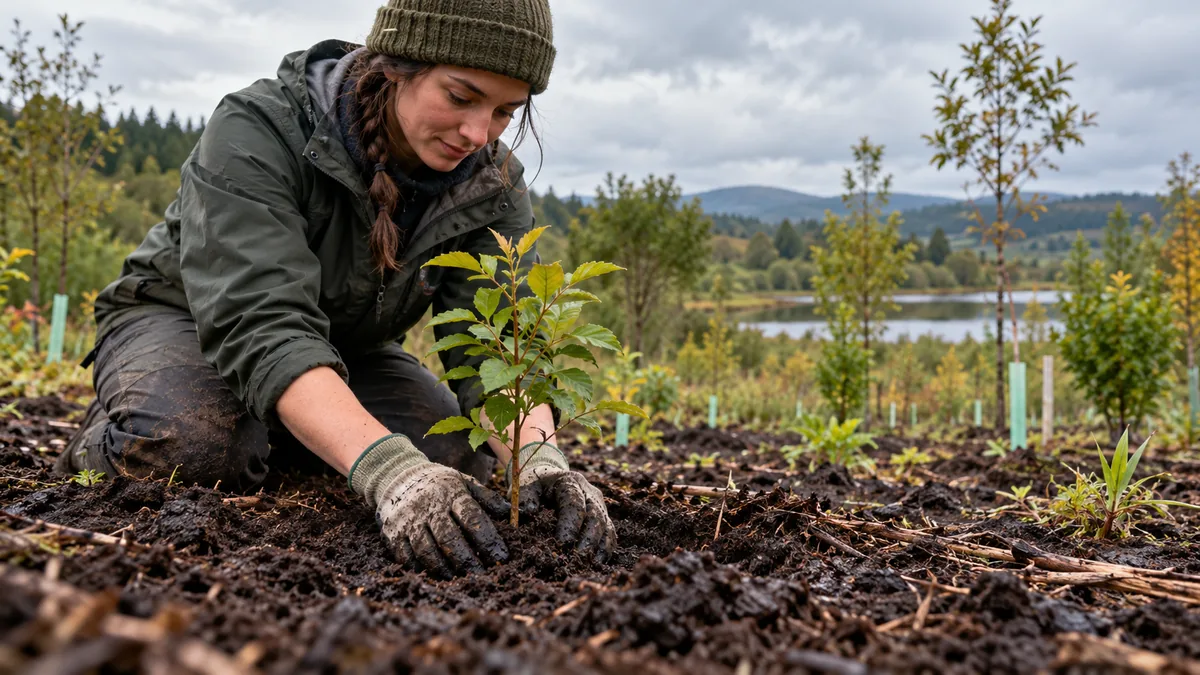
5 million hectares planted or replanted/year × 1,000 seedlings/hectare ≈ 5 billion seedlings/year
Planting is an action, not a forest outcome
Tree-planting announcements often emphasize enormous totals. The first question is what the total counts. Here a seedling counts when a young tree is physically planted in soil during the year. A seed in a nursery tray, a naturally regenerated sapling, and a promise to plant later do not count. A replacement seedling planted after a previous failure does count as a new planting action. That definition deliberately measures activity rather than survival, growth, restored habitat, or carbon stored.
A useful working estimate is around five billion tree seedlings planted worldwide each year. It should not be quoted as an audited global count. Planting happens in commercial forests, restoration projects, farms, gardens, and urban streets, and those activities are reported differently. The model will use area planted and planting density to reach an order of magnitude, then test whether the implied work could be carried out by people and machines.
Multiply area by planting density
Assume five million hectares are planted or replanted in a year across the relevant activities. At 1,000 tree seedlings per hectare, the result is five billion. One hectare is 10,000 square metres, so this density gives roughly ten square metres per seedling, comparable to spacing a little over three metres apart in a simple square grid. FAO guidance illustrates a spacing of three metres by three metres, about 1,111 trees per hectare. That supports our density as a reasonable illustrative anchor, not the global planted area.
The five-million-hectare area is an assumption, not a figure extracted from the FAO spacing guide. Some restoration aims for far fewer planted trees and relies on natural regeneration; some intensive projects plant more densely. Counting a nursery shipment as a planting would inflate the total, while omitting replacements would reduce it. If the area were only two million hectares at the same density, we would get two billion. At ten million, we would get ten billion. The wide range is part of the honest answer.
Check whether the labor is conceivable
For a second route, imagine one million people worldwide who spend an average of 250 working days a year planting trees and average twenty planted seedlings per day. That also gives five billion actions. Twenty per day is deliberately low for a dedicated planting crew, but the model spreads work across many part-time participants and days lost to preparation, transport, weather, and maintenance. The number of people is highly uncertain; the labor route is a plausibility test, not a workforce survey.
The reverse daily rate is about 13.7 million seedlings planted across the world on an average calendar day. Real planting is seasonal and clustered around suitable moisture and temperature, so actual peak days would be much larger and dormant days far smaller. FAO advises choosing locally appropriate planting periods. The average-day calculation is useful only as a physical-scale check: it asks whether a global network of crews and volunteers could plausibly carry out that many placements.
Why planting totals mislead
A planted seedling is not automatically a surviving tree. Drought, poor site preparation, browsing animals, inappropriate species, and inadequate aftercare can reduce survival. Conversely, natural regeneration can restore a landscape with fewer planted seedlings. Counting inputs alone may reward a project for planting too densely or failing to maintain earlier plantings. A useful outcome measure would revisit plots after several years, measure survival and ecological fit, and compare with a realistic baseline.
Another ambiguity is repeated planting on the same land. Replanting after harvest or replacing dead seedlings creates new planting events but not the same amount of net forest expansion. Our event definition allows those actions, while an estimate of new forest area would not. FAO forest-area data and planting guidance describe different objects; neither is a direct global count of our defined planting events. Clear units stop a campaign statistic from quietly turning into a claim about ecosystem recovery.
Build a version for one landscape
Imagine a one-hectare site. Mark approximate three-metre spacing and count how many positions fit after subtracting paths, rock, streams, or existing trees. Then decide whether the goal is a timber stand, habitat mosaic, riparian strip, or urban shade. The appropriate density may change sharply. This local exercise makes the thousand-per-hectare assumption feel tangible before you scale it to millions of hectares.
The Fermi answer is best used as a range of billions, with five billion as a transparent midpoint under stated assumptions. Area and density form the primary model; planter-days provide a separate operational check. The deeper lesson is to keep actions, surviving trees, and forest outcomes distinct. Once those are separated, better field data can improve the estimate without disguising what was actually measured.


