World in numbers · Number story 147
How many picture postcards are mailed in a year?
A small assumed slice of a vast postal stream, tested against how often people might write one.
7 minute read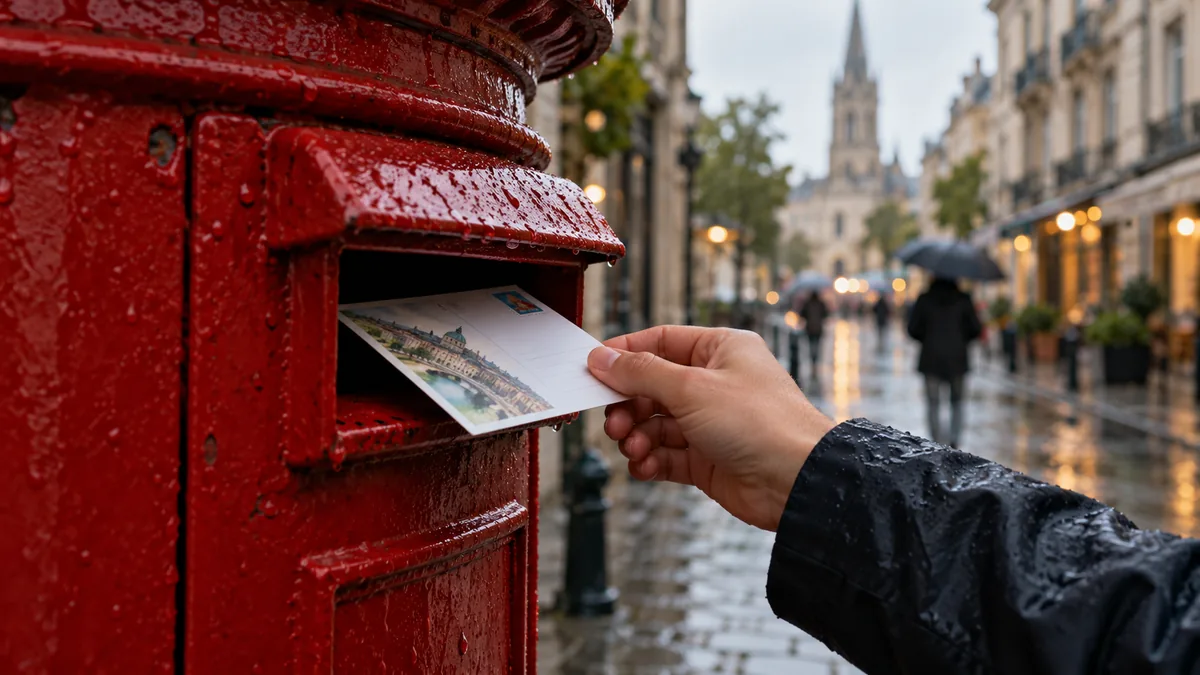
about 200 billion letter-post items/year × 1% assumed picture-postcard share ≈ 2 billion postcards/year
A postcard is not every piece of mail
Picture postcards seem old-fashioned beside instant photographs and messages, yet they remain a tangible way to say, “I was here.” The question is how many physical picture postcards people actually put into the mail in a year. We count a card once when it is mailed, whether sent domestically or abroad. We exclude unsent souvenir cards, ordinary greeting cards, advertising flyers, and parcel inserts. An international card that passes through several postal networks is still one mailed postcard, not several.
A working estimate is about two billion mailed picture postcards yearly. That is not a figure reported by the Universal Postal Union. Postal systems publish much broader letter-post traffic; the postcard share must be assumed or measured separately. Making that distinction is central to the article. A good Fermi model can use a real anchor without pretending that the anchor directly measures the narrow event we care about.
Take a small slice of letter post
A UPU historical series places 2024 domestic letter traffic near 195 billion items and international letter traffic near one billion. Round the combined scale to 200 billion items for easy mental arithmetic. If picture postcards represented one percent of that flow, the result would be two billion mailed cards a year. The one-percent share is entirely our modeling assumption. It could be wrong by several times, especially because the UPU category aggregates different kinds of mail.
At a half-percent share the model gives one billion cards; at two percent it gives four billion. That span is still much smaller than all letter post. The main advantage of the postal-stream route is that it prevents a postcard estimate from exceeding the system carrying it. It does not tell us the correct fraction. To narrow the fraction, we would need a representative sample of mail classes across countries, not a photograph of a crowded tourist shop.
An independent sender model
Now forget the postal volume. Suppose 500 million people worldwide mail picture postcards during a year and each sends four. That also gives two billion mailed cards. Four may represent one holiday with several recipients, or a few separate occasions. The number of senders and frequency are assumptions, but they answer a different question from the mail-share model. Instead of asking what fraction of all letters are postcards, we ask how a subset of people might behave.
Reverse the answer over an eight-billion-person world and it becomes one mailed picture postcard per four people per year. That is a population average, not a claim that one quarter of the world mails exactly one. The behaviour is likely concentrated among travellers, collectors, school groups, and families with distant friends. Digital alternatives make frequency difficult to generalize. Still, the implied average is not an obvious impossibility, which is all a reasonableness check needs to establish.
Beware the international-mail trap
The international letter series is only a thin part of global letter traffic. A postcard sent to a friend in the same country belongs in domestic traffic even if the image on it shows a famous international destination. If we estimated postcards only as a fraction of cross-border letters, we would miss the domestic majority of possible cards. Conversely, adding cards sold but never mailed would inflate the number beyond our definition.
UPU figures are useful context for the carrying network, not postcard-specific evidence. National postal operators may classify cards differently or combine postcards with other letters. Business mail is also a large part of the broad denominator, so one percent should not be read as one percent of personal messages. The distinction explains why a detailed denominator is not automatically a precise numerator. We must carry uncertainty through the conversion rather than hide it in a decimal.
How to make the estimate better
Find a postal operator that publishes postcard volumes or ask a local post office how cards are classified. Compare a few countries with different tourism patterns. The next improvement would be to estimate picture postcards as a fraction of personal, stamped mail rather than all letter post. That could give a more stable ratio, but only if the narrower denominator is available and measured consistently across countries.
Until then, two billion is a transparent working answer with a wide plausible range. It is more useful than a confident number without a definition because anyone can change the postcard share, or build an entirely different model from senders and cards per sender. This is the core Fermi habit: start from a measurable system, label the unmeasured fraction honestly, and challenge the result with human behaviour.


