Things we make · Number story 139
How many clay bricks are laid in buildings each year?
A wall-area model that turns a familiar building material into a world-scale count.
7 minute read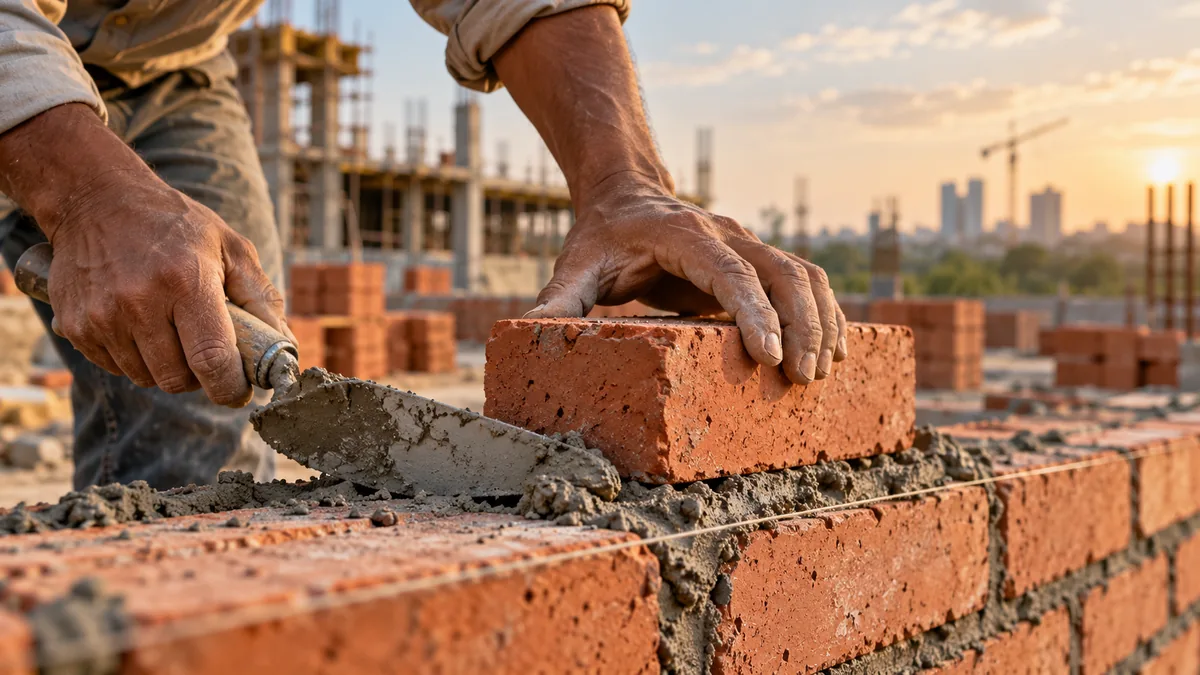
2 billion m² of brick-bearing wall/year × 50 standard-brick equivalents/m² ≈ 100 billion bricks/year
A brick is a unit with edges
A brick wall makes a huge quantity visible one piece at a time. Ask how many bricks are laid worldwide in a year, though, and the counting rules become less obvious. This estimate concerns clay-brick equivalents installed in building walls. It excludes concrete blocks, road paving, and bricks manufactured but left in stock. It treats a large hollow clay unit as several standard-brick equivalents if necessary, because dimensions vary widely. The target is construction activity, not kiln output. These choices make the answer more meaningful than a bare global number.
Our working figure is about one hundred billion standard-brick equivalents laid annually. This is a Fermi estimate, not a measured production statistic. It may differ substantially from industry totals that include different sizes, paving products, or unsold inventory. The construction sector is globally significant, but not every new building uses brick: steel, timber, concrete, stone, and other materials compete. Any credible calculation must include a filter for brick-bearing wall area instead of multiplying all new floor space by a brick rate.
Build the wall-area model
Assume that new construction and major refurbishment together create about two billion square metres of wall that will receive clay bricks in a year. Assume fifty standard-brick equivalents per square metre of wall. Multiplication gives 100 billion bricks. Both factors are explicitly hypothetical. The first bundles the global building pace, the share with masonry walls, and the number of wall surfaces per building. The second bundles brick size, mortar joints, and wall thickness into one practical conversion rate.
Area is a better intermediate quantity than population because masonry is used unevenly. A house with several internal brick partitions can contain more brick area than one with only a decorative exterior face, even at the same floor area. A high-rise may put most structure into concrete and glass. A careful model could start from new floor area by region, multiply by brick-adopting share, then convert floor area to wall area. Our single wall-area assumption compresses those steps while making it clear where uncertainty lives.
Test the scale from labor
For a check independent of the wall-area multiplication, imagine five million workers around the world regularly laying clay bricks, each averaging twenty thousand standard-brick equivalents over a working year. That also yields 100 billion. Twenty thousand a year is around eighty per day over 250 workdays. This deliberately low-seeming rate could include preparation, moving materials, mixing mortar, weather delays, and complex wall details. The worker count is highly uncertain, but the implied productivity does not obviously violate physical constraints.
A second interpretation is about thirteen bricks per person worldwide each year if the world population is rounded to eight billion. That is a compact way to feel the scale, but it is not a statement that every person lives in a brick building. Construction is concentrated in growing cities and regions. The per-person division is an interpretation of the result, not fresh evidence. The labor route is the more independent test because it starts from a different mechanism: people and workdays rather than square metres.
Where uncertainty enters
The largest uncertainty is probably the global area of brick-bearing walls. Local building codes, climate, materials prices, labor costs, and architectural preferences change the fraction dramatically. Clay bricks can also be reused from demolished buildings; those reused units would count when laid again but would not appear as new kiln output. Conversely, damaged bricks produced but never installed should not count. This is why a factory-production benchmark cannot be substituted for installed bricks without an adjustment.
The United Nations Environment Programme reports that the building stock and construction sector have a very large global footprint, and its recent report puts global building floor area in the hundreds of billions of square metres. That broad context makes a multi-billion-square-metre annual construction-related assumption worth testing, but the report does not directly measure our brick wall area or validate the one-hundred-billion result. We keep the benchmark and the inferred model separate so that source authority is not borrowed for an assumption the source did not make.
Rebuild the estimate for one building
Take a building you can picture. Sketch its exterior wall length and height, subtract doors and windows, then estimate what fraction is actually brick. Multiply the remaining square metres by a brick-equivalent rate appropriate to the unit size. That exercise reveals why wall thickness and openings matter. Scaling from one building to the world is hazardous, but it gives the conversion factor a physical feel and may expose an implausible assumption in the global model.
A useful final range might be fifty to two hundred billion standard-brick equivalents under reasonable alternative wall-area and unit-size assumptions. The key lesson is not to memorize one end of the range. It is to keep floor area, wall area, manufactured units, and laid units distinct. Once the boundary and dimensions are explicit, the estimate can be improved with regional construction data or material surveys without changing its basic structure.