Movement · Number story 137
How many escalator rides happen around the world each day?
A passenger-count model for moving stairs, checked against the flow of urban trips.
7 minute read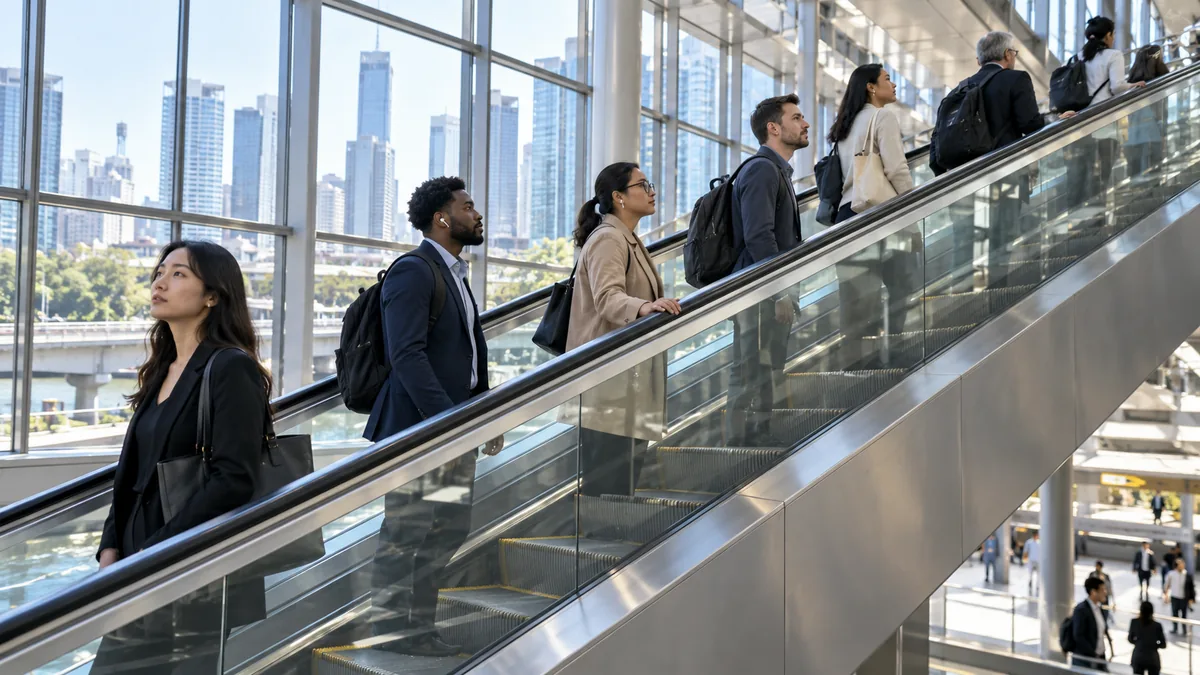
1 million operating escalators × 12 active hours/day × 100 passenger rides/hour ≈ 1.2 billion rides/day
The ordinary journey inside the journey
An escalator ride can be a tiny part of a longer trip. You may step on one at a station, another at a shopping centre, and a third at an airport before reaching your destination. We count each boarding by each passenger as a separate ride. If four people stand on one escalator together, that is four passenger rides, not one equipment movement. A person who walks up beside an escalator does not count. Elevators and moving walkways are outside the boundary. Naming the unit prevents a common mistake: multiplying the number of escalators by the number of times each machine starts, even though many run continuously.
A working answer is about 1.2 billion passenger rides on escalators per day. This is not a published global traffic count. It is a deliberately round estimate that allows us to ask whether the fleet, operating hours, and passenger flow could plausibly generate that many boardings. The calculation is interesting because daily use is concentrated. An airport connector may be busy for long stretches; a small store unit may remain almost empty after closing time.
Build the fleet model
Assume one million operating escalators worldwide. Give each twelve active hours a day and an average of one hundred passenger boardings per active hour. One million times twelve times one hundred equals 1.2 billion rides per day. The twelve hours already folds in closed buildings and low-traffic periods; it does not claim that every machine literally switches off after twelve hours. Likewise, one hundred per hour is a day-level average, not the peak mechanical capacity of a crowded station escalator.
Changing the fleet assumption changes the answer in direct proportion. Half a million comparable units would give 600 million rides. Two million would give 2.4 billion. Usage is probably even more important than the fleet count because machines in high-volume transit systems are not interchangeable with machines serving quiet commercial buildings. A refined version would split escalators into transit, retail, airport, and other groups, then assign each group a different daily flow.
Check with people instead of machines
For an independent check, imagine 500 million people using an escalator on a given day and averaging two boardings each. That gives one billion rides, close to the machine-based answer. This route does not require us to know the escalator fleet. It asks whether roughly one person in sixteen worldwide might use moving stairs during a day, recognizing that participation is heavily urban and that many residents of smaller communities will not see an escalator at all.
Reverse division offers another quick view: 1.2 billion rides across a round eight-billion-person world is 0.15 rides per person per day. The United Nations population series supports using eight billion as an order-of-magnitude denominator, not our escalator usage assumptions. Concentrated use allows frequent commuters and shoppers to generate many rides while most people generate none. If the model implied dozens of daily escalator trips for every human being, it would be clearly wrong. Here the implied rate is at least conceivable.
Why the day is not uniform
The word daily hides a moving pattern. Train stations surge with commuting; shopping centres peak on weekends and holidays; airports respond to flight schedules. Some units remain under repair or are deliberately stopped to save energy. Others run longer than our assumed twelve active hours. A world average combines all of these states. It should not be used to design the capacity of one building, where peak fifteen-minute flows matter more than average daily boardings.
There is also a counting problem at interchanges. A commuter riding up one escalator and down another contributes two rides but only one person. Multiplying passenger counts by machines without first deciding whether the unit is people, trips, or boardings can quietly double count. We deliberately count boardings, so repeat use is allowed. The same distinction appears in transport statistics: one traveler can make several separate transit rides in a day.
Make the estimate your own
Start with a place you know and watch one escalator for five minutes. Count boardings, scale to an hour, and then decide how many hours that rate would actually persist. Do the same for a quiet unit. If you then guessed the worldwide mix of busy and quiet locations, you would have a stronger global model than a single flow assumption. A short observation cannot settle the fleet count, but it can sharply improve your sense of plausible throughput.
The result is best read as an order-of-magnitude statement: hundreds of millions to a few billion rides could be reasonable under alternative assumptions, with 1.2 billion as a transparent working centre. The useful insight is not the final digit. It is that one ordinary movement, repeated across a worldwide fleet for many hours, can become a billion-scale daily event. Keep the unit and the active-hours assumption in view, and the calculation remains open to revision.